
Content
Mary Shelley
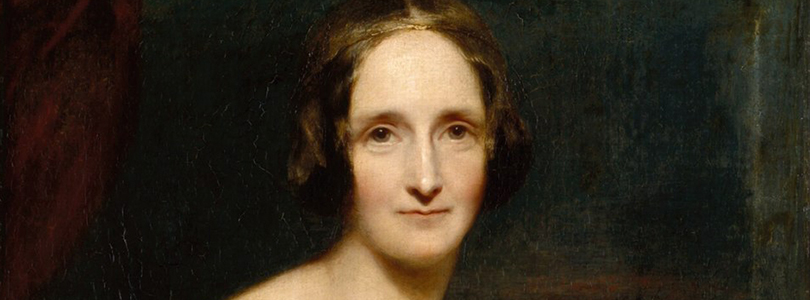
Mary Shelley, 1840
Frankenstein's mother: wild girl, far-sighted author
The monster's mother – Mary Wollstonecraft Godwin was born in London on 30 August 1797. She was the daughter of prominent freethinkers and intellectuals: her mother was the writer and early feminist Mary Wollstonecraft, who wrote A Vindication of the Rights of Woman in 1792, a seminal text of the women's rights movement. Unfortunately, Wollstonecraft died shortly after Mary's birth.
Her father, William Godwin, was a prominent author, publisher and founder of philosophical anarchism. He polarised public opinion with his radical ideas, including the abolition of marriage (which he later moderated). After the French Revolution, as the political climate in England became more conservative, Godwin lost popularity and the family struggled with financial difficulties.
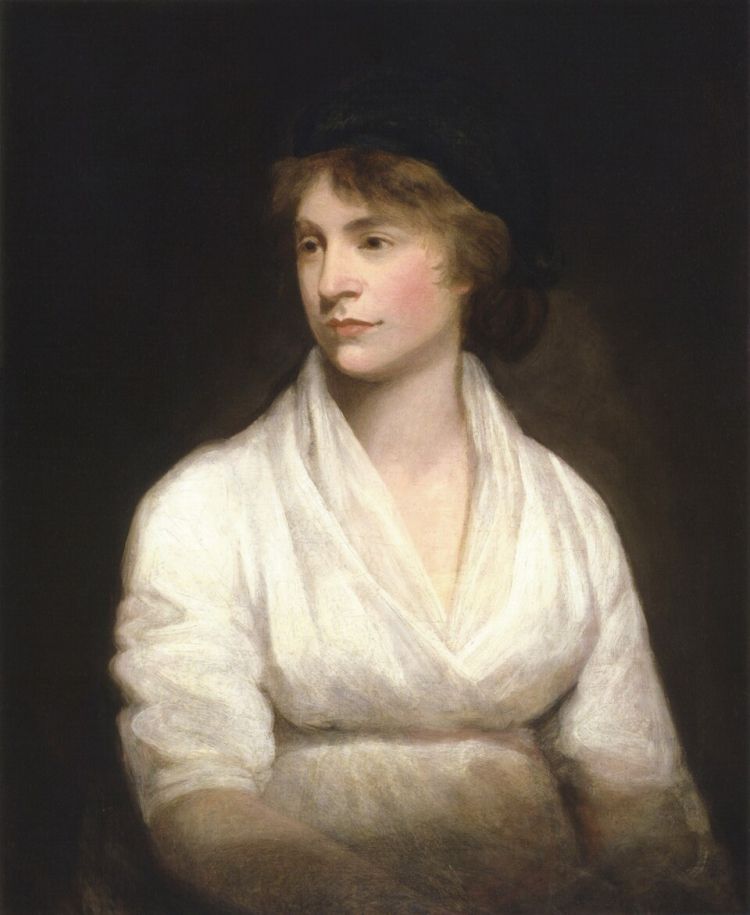
Mary Wollstonecraft, 1797
Mary grows up with several half-siblings and step-siblings, all of whom help run the family bookshop and publishing house. Mary does not receive a formal education, as was customary at the time, but her father teaches her. From an early age, she also moves in intellectual circles, surrounded by writers and thinkers who visit her father. At the age of 11, she published a children's book entitled ‘Mounseer Nongtongpaw; or, The Discoveries of John Bull in a Trip to Paris’ through her father's publishing house.
Eloping with the young rebel
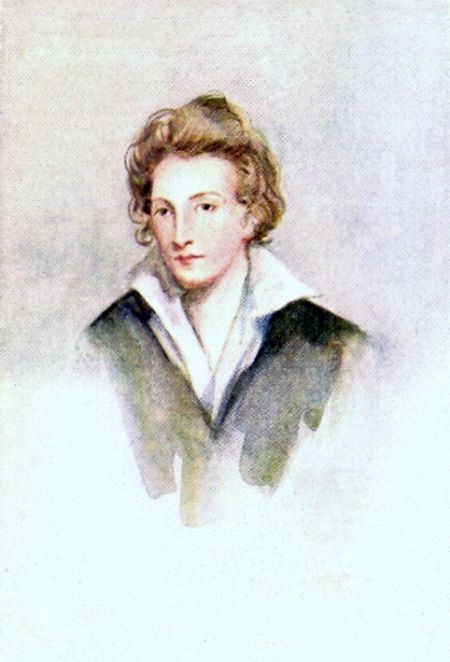
Percy Bysshe Shelley
At the age of just 16, Mary fell in love with the wild young poet Percy Bysshe Shelley. Coming from an old aristocratic family and having grown up extremely privileged, P. B. Shelley stood out as a rebel at Oxford University and was expelled for writing an atheistic treatise. When the two met, Shelley was 21 years old and had not yet written the poems that would make him one of the most famous figures of English Romanticism. But he was a dazzlingly handsome, ambitious young poet who wanted to turn the world upside down. He was also married, already had one child and his wife was expecting another. But Percy Shelley considered marriage outdated, believed in free love and cited William Godwin, among others, as his inspiration.
A relationship as scandalous as it is creative begins, which will repeatedly be a major topic of discussion among the English public. Mary and Percy elope together under cover of night and fog and flee to the mainland. They live together in a ‘wild marriage’ for a long time and have four children in quick succession.
Mary's stepsister and confidante Claire Clairmont, a witty and impulsive woman, is always with them. She soon gives birth to a child fathered by the greatest “enfant terrible” of British literature: Lord Byron, one of the most famous poets of his time and father of computer pioneer Ada Lovelace.
Year without a summer – summer of ghost stories
Mary Godwin and Shelley spend one of the most famous holidays in literary history with Lord Byron. The year is 1816 – the year without a summer. The previous year, the mighty Tambora volcano had erupted in Indonesia, leading to a global deterioration in the climate. Temperatures fell, it rained incessantly, there were crop failures, famines – and the invention of the bicycle. The wild young writers spent this gloomy summer of endless rain at the Villa Diodati in Cologny on Lake Geneva. They pass the time with intoxicants, ghost stories and conversations about galvanism, electricity and the animation of dead matter. Finally, they agree on a competition: everyone is to write a horror story.
No significant works emerge from the two established greats, Byron and Shelley. But Byron's personal physician, John Polidori, writes ‘The Vampyre’, the first modern vampire novel, which will strongly influence all later texts in the genre, including Bram Stoker's ‘Dracula’. However, the greatest success is achieved by 19-year-old Mary, who emerges as the creative winner of this competition. One of the most famous characters in literary history is born.
The vision of the artificial human
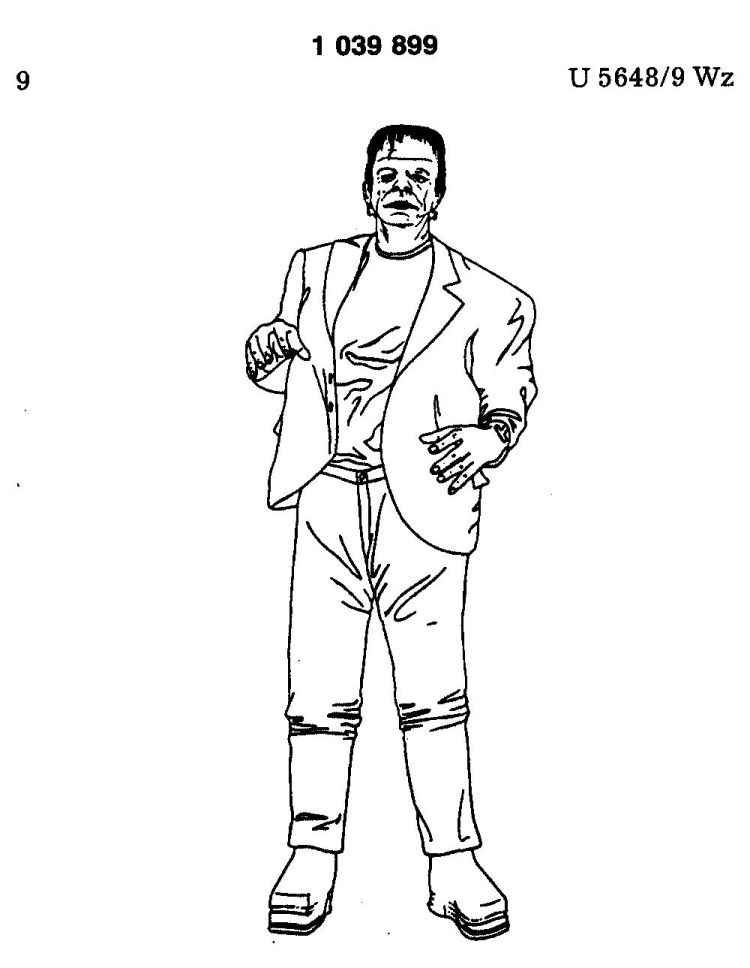
Trademark registered in 1982 by Universal City Studios LLC (1039899), based on Boris Karloff's portrayal of the ‘monster’ in the 1931 film
In an atmosphere of thunderstorms and gloom, Mary had a kind of daydream vision, as she later wrote: a pale student of the ‘unnatural arts’ kneels before a composite being that suddenly comes to life. This scene gives rise to an epoch-making novel about creation, responsibility and humanity: ‘Frankenstein; or, The Modern Prometheus’.
Those unfamiliar with the novel often confuse the facts: Frankenstein is not the name of the “monster”, but rather the scientist who creates an artificial human being at the University of Ingolstadt. Victor Frankenstein is not a sinister alchemist, but a modern scientist who methodically collects data, tests procedures – and then refuses to accept the consequences and take responsibility. We also find this problem in current discourses on biotechnology, artificial life and AI. Frankenstein's creature is unsightly, impulsive and socially unacceptable – like an unwanted, maladjusted child. His creation becomes Frankenstein's nemesis; a breathless and brutal, yet philosophically underpinned chase across the globe begins and ends with a showdown in the Arctic.
One of the most famous characters of all time
Latvian schnapps brand, registered in 2016 (1304094)
In January 1818, the novel was first published anonymously in a print run of five hundred copies by a largely unknown London publisher. Since then, the text has been considered the cornerstone of science fiction and horror literature. In 2016 alone, almost 50,000 copies of the novel were sold – a hundred times as many as the first edition. One of the original copies will be auctioned in 2021 for $1.17 million – a record for a printed work by a woman.
The influence of ‘Frankenstein’ on popular culture cannot be overestimated. Numerous ‘Frankenstein’ trademarks have also been registered, for example by film studios (396127622), winemakers (3020080544295), whisky producers (017151804), breweries (3020221005409)and a car repair shop (018505568). In the 20th century, it was primarily the repeated film adaptations that shaped our image of Frankenstein. The most influential of these is undoubtedly Boris Karloff's portrayal of the creature in the 1931 film.
Loss and exclusion
Brand of an event agency, 2023 (3020231086142)
Two fundamental themes of the novel – exclusion and loss – recur repeatedly in Mary Godwin's own life. In 1816, Godwin and Shelley return to England. In the same year, they are finally able to marry – because Shelley's wife commits suicide. Mary's half-sister Fanny Imlay also takes her own life that year. The Shelleys continue to have financial worries and suffer rejection from their families and society. They move to Italy. There, two of their children die within a short period of time, and Mary gives birth to a fourth child (Percy Florence, the only one who will reach adulthood). In 1822, she nearly died from a miscarriage. A few days later, on 8 July 1822, Percy Bysshe Shelley drowned in a sailing accident in the Gulf of La Spezia.
Productive author

Trademark application for toy retailer, 2020 (302020065043)
After her husband's death, Mary Shelley returned to England and devoted herself to his estate and the project of making him immortal. She arranged for the publication of his works, including his unpublished writings. But beyond that, she continues to be very productive as an author. Her complete works include several novels, short stories, plays, essays, poems, reviews, biographies and travelogues. They testify to her intellectual brilliance and a deep understanding of the social and political currents of her time.
Besides Frankenstein, her best-known work today is The Last Man (1826), a dystopian tale about the destruction of humanity by a plague. It was widely read again during the COVID pandemic and is often considered her best work. Mary Shelley died in London on 1 February 1851, presumably from a brain tumour.
Text: Dr. Jan Björn Potthast, Bilder: Richard Rothwell National Portrait Gallery / Public domain via Wikimedia Commons, John Opie / National Portrait Gallery / Public domain via Wikimedia Commons, unbekannt / Public domain via Wikimedia Commons, DPMAregister
Last updated: 3 March 2026
Not only protecting innovations
Social Media