Content
Consequences of buying counterfeit goods
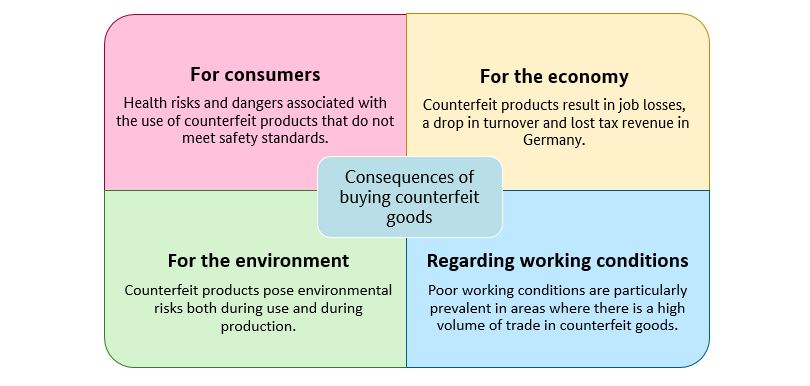
Counterfeit products are not an isolated phenomenon, but have far-reaching consequences. As they appear to be genuine products but are not subject to the same strict production controls, they capitalise on the trust placed in the quality, manufacturing conditions and testing procedures of the originals. At the same time, they often pose significant risks to consumers, cause economic damage, lead to poorer working conditions and have a negative impact on the environment.
For consumers
Defects found in counterfeit products are very often serious. In a sample from an EUIPO study, 97 per cent of the counterfeit products seized by market surveillance authorities were classified as serious. The most frequently reported hazard (32 per cent) was exposure to hazardous chemicals and toxins, where even brief exposure can cause acute or chronic health damage (
 EUIPO 2019). Other health risks identified included microbiological hazards and risks of injury, such as burns, electric shocks or strangulation ( EUIPO/OECD 2022).
Product groups posing particularly high risks to safety and health include food, medicines, perfumery and cosmetics, soap, clothing and textiles, electrical machinery and electronics, watches, toys and vehicle parts ( EUIPO/OECD 2022).
Europol also warned of the health risks posed by counterfeit products seized during its operations. These included, amongst others, Botox, vitamin supplements, sexual enhancers and slimming injections. (Further information in the reports from Europol 2023, 2024, 2025).
For the economy
Counterfeit goods result in job losses, a decline in turnover and lost tax revenue for the state. Germany is particularly hard hit by this: according to a study from 2025 ( Mapping Global Trade in Fakes 2025), Germany was the top destination for imports of counterfeit goods by value, ahead even of the USA.
Estimates from a EUIPO study show that the legitimate clothing industry lost around 12 billion euros in turnover every year between 2018 and 2021. This corresponds to approximately 5.2 per cent of total clothing turnover in the EU. There are also studies for the mechanical and plant engineering sector; EUIPO study puts the estimated loss for 2024 at 4.1 billion euros annually – a sum that could secure just under 16,000 jobs in the industry.
Contrary to the popular belief that counterfeiting primarily harms large companies, SMEs are often particularly affected, as they lack the capacity to deal with the consequences of intellectual property rights infringements ( Study OECD 2023).
For working conditions
A Study by the OECD highlights the link between working conditions and counterfeit goods: countries from which counterfeit goods originate particularly frequently tend to have higher levels of child labour (including in hazardous sectors), more informal jobs, longer working hours, weaker worker protection and a higher incidence of fatal workplace accidents. Furthermore, it is evident that the higher the value of exported counterfeit goods, the more widespread forced labour is in that country.
For the environment
Counterfeit products pose environmental risks when used, particularly in the case of counterfeit chemicals or pesticides, which are used without proper oversight and can harm the environment and ecosystems.
However, the production and disposal of counterfeit products can also have environmentally harmful consequences due to a lack of standards and controls. This applies in particular to the use of toxic dyes, the illegal disposal of chemicals and unregulated air pollution EUIPO/OECD 2022).
Picture: gettyimages/Edwin Leung, iStock.com/makyzz and DPMA, Picture 2: DPMA
Last updated: 7 May 2026
Not only protecting innovations
Social Media