Content
What are fakes and how can you spot them?
What are "fakes"? What is meant by product and brand piracy?
Product or trademark piracy involves the manufacture and sale of goods that infringe intellectual property rights, i.e. industrial property rights (such as patents, trademarks and designs), copyright or trade secrets. For example, by the unauthorised affixing of another party's trademark or a very similar-looking trademark to comparable goods (so-called trademark piracy) or by imitating a protected design. Such unauthorised imitations of original goods are also colloquially referred to as "fakes".
What are dupes?
Dupes (derived from the English word "duplicate") are so-called "affordable alternatives". A dupe is intended to resemble a branded product in appearance or effect, without infringing the original manufacturer’s intellectual property rights. Dupes are therefore marketed under their own brand name. Dupes are particularly common in the branded perfume sector.
-
How does trademark protection actually work?
Trademarks serve as an indication to consumers of the origin of a product. They build trust and help consumers recognise a product, distinguish it from competitors' offerings, and make informed purchasing decisions. Companies invest heavily in building a specific brand reputation. They research trademarks, register them, use them to promote their products, and must also ensure that third parties do not infringe their trademark at a later date.
This is what trademark infringement might look like:
- A sign that looks exactly the same as an existing trademark for the same classes of goods and services
- A sign that looks exactly the same or similar for the same or similar classes of goods and services. The prerequisite is that there is a so-called likelihood of confusion among the relevant public.
- A sign that looks exactly the same as or similar to a well-known trademark regardless of the goods/services, if this unfairly exploits or impairs the distinctive character or reputation of the well-known trademark without justifiable grounds
No one may, without the trademark owner’s permission, manufacture, offer for sale, put into circulation, use or possess goods that infringe the trademark in the course of trade.
Items that are particularly prone to counterfeiting
According to figures from the German Federal Customs Administration in the  annual customs statistics, in 2024, measured by the number of seizures, the majority of confiscations involved personal accessories such as sunglasses, bags, watches and jewellery (6,756). The next category was clothing and accessories (5,637).
How to spot "fakes"
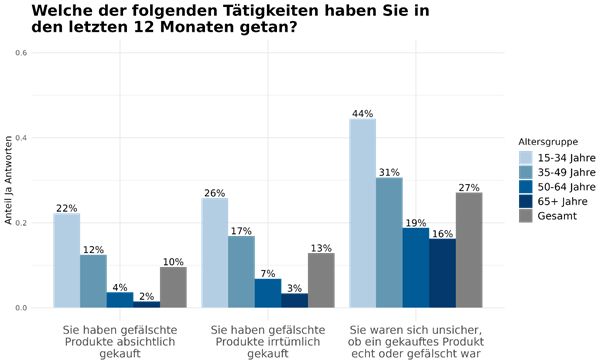
2023 Survey by the European Union Intellectual Property Office
A 2023 survey by the European Union Intellectual Property Office shows that 10 per cent of Germans have already knowingly purchased counterfeit products. For 13 per cent, this happened unintentionally, whilst 27 per cent were unsure whether they had bought a counterfeit product. In the 15 to 34 age group, the proportion of those unsure was as high as 44 per cent.
As counterfeiters are highly creative, follow trends and are becoming increasingly professional, it is not always easy to identify counterfeits. Many consumers have often – unconsciously or even knowingly – bought counterfeit products.
These points indicate product counterfeiting:
- Low price: The first indicator of a counterfeit is often the very low price – frequently linked to a flash sale designed to tempt people into making impulsive purchases.
- Poor quality: Furthermore, the quality is often substandard, and rough workmanship or faulty manufacturing can be signs that the product is not genuine.
- Missing or incorrect labelling: For products covered by EU directives (e.g. toys, electronics, machinery), the absence of a CE or TÜV mark may indicate a counterfeit. However, even a logo does not guarantee that the product is genuine. Sometimes the security label, such as a hologram seal, is also damaged or covered up.
- Poor customer reviews: In online retail, negative customer comments can serve as a warning sign.
- Consistent availability: Some genuine products are not always in stock due to complex manufacturing processes and supply chains. Consistent availability in large quantities could therefore also be a red flag.
- Seller details: You should be cautious if products traditionally manufactured in Europe are being offered by sellers from non-EU countries. The same applies if certain products are not being offered via the usual distribution partners.
- Faulty product listings: Spelling mistakes in the product description or poorly taken photos can also be a red flag. However, the use of AI tools has recently led to a decline in such obvious errors, making it harder for unprepared consumers to spot these listings.
The phenomenon of fake influencers
One problem in online retail is influencers who promote counterfeit branded goods. This is because more and more consumers are buying products based on recommendations from influencers on social media. However, just because a product is recommended by someone we follow online does not mean it is genuine.
Further information:
How you can prevent it
Before making a purchase, checking a few specific things can help ensure you don’t unwittingly fall for counterfeits.
- Is the spelling of the brand name and the brand’s presentation correct?
- Are the instructions for use in order?
- For online shops, it helps to take a close look at the domain and the legal notice.
- Be wary of social media adverts containing links to fake websites.
- Opt for purchases on account or always use secure payment services.
- Beware of fake shops: These are websites that copy content from well-known brand manufacturers and appear professional and reputable. They offer cheap (branded) goods which, once paid for in advance, are either delivered in poor quality or not at all. The Fakeshop-Finder der Verbraucherzentralen (Consumer organisations' fake shop detector) provide useful guidance on how to avoid falling for these scams.
- Avoid impulse buys and do not let yourself be pressured by time-limited offers; do not trust offers that seem too good to be true (e.g. the possibility of buying prescription-only medicines online without a prescription).
- Use the authentication methods provided by rights holders, such as holograms, RFID chips or NFC technology, to verify the authenticity of the products.
- Another safe option is to buy directly from the original manufacturer.
Picture: gettyimages/Edwin Leung, iStock.com/makyzz and DPMA, Picture 2: DPMA, Bild 3: iStock.com/makyzz und DPMA
Last updated: 6 May 2026
Not only protecting innovations
Social Media