Content
Young people explore – and discover the ins and outs of intellectual property
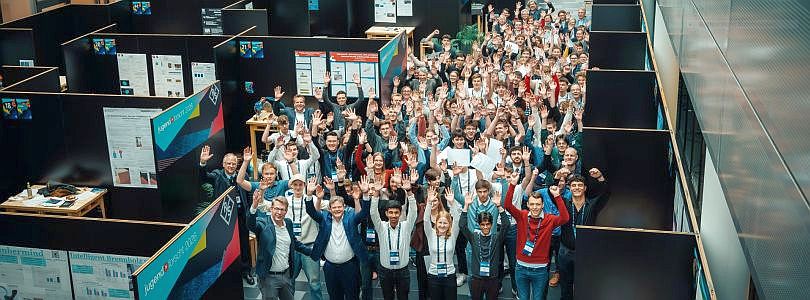
Exciting projects and enthusiastic participants at the final of the "Jugend forscht" state competition in Bavaria.
The national "Jugend forscht" competition will take place in Herzogenaurach from 28 to 31 May – "Patent Coaching" was open to Bavarian participants for the first time as a pilot project – DPMA President Eva Schewior: Industrial property rights as the basis for successfully bringing inventions to market

DPMA President Eva Schewior with Vincent Nack
The end of the grandparent scam? Vincent Nack has developed a system, with the help of artificial intelligence, that automatically cuts off fraudulent calls to landlines. At the end of May 2026, Vincent Nack will compete in the "Working World" category at the national "Jugend forscht" competition. This time, he took early steps to protect his innovation as intellectual property – and filed a patent application with the help of his parents’ lawyer. This was a lesson he learnt from his national victory at "Jugend forscht" a few years ago, when he competed with an emergency braking assistance system for bicycles. Over the past four years, Vincent Nack has intensively built up and expanded his knowledge of intellectual property rights. This becomes clear in the interview we conducted with him as part of the Bavarian state final of "Jugend forscht".
Questions and sustainable learning processes relating to patents and utility models
Questions, "aha" moments and lasting learning processes relating to technical property rights – a collective term for patents and utility models. – They were a constant presence at the Bavarian state final of "Jugend forscht" on the premises of the sponsoring company "Rhode & Schwarz" in Munich. The pupils who, following the Bavarian rounds, will take part in the national competition in Herzogenaurach with their projects, do so with a broader understanding of intellectual property rights.
More than 11,000 pupils are taking part
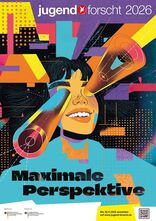
National Competition 2026 from 28 to 31 May
The competition has been and continues to be held in stages at regional, state and national levels. In total, more than 11,000 school pupils are taking part. The young researchers who have qualified for the national competition will present their projects from 28 to 31 May at the sponsoring company, Schaeffler AG, in Herzogenaurach. To make these events possible, more than 8,000 volunteers and 52 sponsoring companies are involved, as Dr Jessica Bönsch, Executive Director of the "Jugend forscht e.V." foundation, explained in Munich. Incidentally, the volunteer judges also include colleagues from the patent examination department of the German Patent and Trade Mark Office.
Patent coaching organised by the DPMA, with the support of the German Patent Attorneys Association
Expanding knowledge of intellectual property rights: On the initiative of the German Patent and Trade Mark Office and with the support of the Chamber of Patent Attorneys, a patent coaching session was held for the first time during the competition days in Munich. A pilot project in Bavaria that could be rolled out across the whole of Germany. The young people were able to submit their work in writing to a patent attorney even before the competition. During the competition, a one- to two-hour discussion then focused on the specific individual project. Is it fundamentally patentable? In other words, is it technical, new, based on an inventive step, and industrially applicable? If so, what specific steps need to be taken to secure patent protection?
The background, which comes as a surprise to many: if an invention is published as part of the "Jugend forscht" competition, even the inventor themselves can no longer apply for a patent afterwards. With such a publication, the invention already forms part of the state of the art; it is therefore "detrimental to novelty" within the meaning of the Patents Act.
Perfected the routine during the evening programme at the bouldering hall
Sixty projects were entered in the Bavarian regional competition. Through the mediation of the Chamber of Patent Attorneys, 170 patent attorneys had agreed in principle to advise the young inventors free of charge. The response was overwhelming. Ten patent coaching sessions took place – a great success for the launch. Other young people became aware of the initiative during the competition and quickly sought support. For instance, a patent attorney drafted the utility model application for Stefan Weiß's "Portable Multifunction Calibrator" project whilst attending the evening programme at the Boulderhalle in Munich.
Eva Schewior: Intellectual property rights are important for attracting investors

Timo Spatz and Sophie Slowik explain their Eco-Electra 2.0 project to Eva Schewior
Tinkering, pottering about and creating based on their own research questions. Presenting the results of their work to a new audience in the exhibition at roughly 15-minute intervals. Networking with pupils from other regions across subject boundaries. During her tour, Eva Schewior, President of the German Patent and Trade Mark Office, praised the pupils' commitment – and was impressed by the breadth and variety of the projects. For more than 60 years, "Jugend forscht" has been a wonderful platform generating valuable impetus for business and society. At the exhibition in Munich, she saw many things that could be successful on the market as products or product improvements – a smart technological aid for the fridge, for example, to prevent food waste. “Industrial property rights form the basis for achieving commercial success with an invention. Patent or utility model protection is essential for attracting investors to bring a unique product to market. It is wonderful that 'Jugend forscht' provides the framework to help young people recognise the value of their work and gain practical know-how on intellectual property rights."
At the final of the Bavarian State Competition, Eva Schewior presented the prizes in the chemistry category. One of the two first prizes went to Timo Spatz and Sophie Slowik for Eco-Electra 2.0, a process for the efficient generation of electricity from algae. This project, too, has a patent pending!
Will there be more women filing patent applications in future?!

Julia Trapp, winner in the Chemistry category; Eva Schewior presented the chemistry prizes
During the event, the President of the DPMA also highlighted the fact that women are named as inventors in less than 10 per cent of published patent applications. "Looking around here, we can hope that the proportion of women among patent applicants will be higher in future," said Eva Schewior as she looked around the room.
An inspiring celebration of science
In total, young people from the categories of chemistry, biology, the world of work, earth and space sciences, physics, mathematics/computer science and technology, as well as eleven projects from the Bavarian regional competition that won a special prize, are presenting their work at the national final. "Answers to the big questions of our time," as Markus Blume, Bavaria's Minister of State for Science and the Arts, put it. "Experiencing curiosity" – this is how Christian Leicher, CEO of Rohde & Schwarz, summed up the competition. And Uli Herwanger, Head of the Bavarian State Competition, spoke of a "festival of science". A festival to which more than 11,000 school pupils from across Germany will contribute in 2026.
Young people are researching – and inspiring. We wish all participants at  National Competition every success and hope they enjoy the experience.
Picture 1: Rohde & Schwarz, Picture 2: DPMA/Sabine Ginster, Picture 3: Jugend forscht e.V., Picture 4: DPMA/Sabine Ginster, Picture 5: Rhode & Schwarz
Last updated: 10 June 2026
Not only protecting innovations
Social Media