Content
World Intellectual Property Day: Fair play, not fakes
To mark World Intellectual Property Day, DPMA President Eva Schewior urges consumers to be cautious when shopping – New DPMA information pages on product and trademark counterfeiting available at dpma.de – World Intellectual Property Day theme: ‘Intellectual Property and Sport’: DPMA information stand in Munich’s Werksviertel district, further events across Germany – Intellectual property protection promotes solutions to societal challenges, strengthens competitiveness and supports prosperity
Press release of 22 April 2026
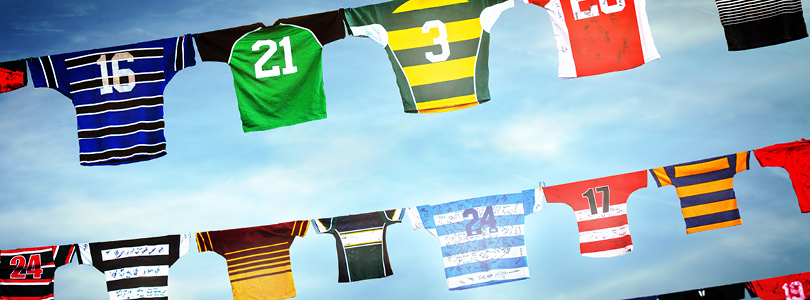
Munich. The next club shirt for the big collection, finally a shirt from your favourite footballer for the autograph session, goalkeeper training from now on only in the kit of your international idol: sports shirts are popular, a multi-billion euro business – and also a breeding ground for product and brand counterfeiters. Anyone who buys fake club shirts, falls for the supposed bargain prices of counterfeit branded sports shoes, or illegally streams sporting events, is involved in a foul play with serious consequences. This Sunday (26 April) marks World Intellectual Property Day. To mark the occasion, Eva Schewior, President of the German Patent and Trade Mark Office, is calling for fair play.
“Anyone who buys counterfeit jerseys or other sports gear is harming their favorite team, supporting organized crime, and potentially putting their own health at risk,” says Eva Schewior. “Product piracy causes billions of euros in damage in Germany every year, thereby not only weakening many innovative companies but also costing thousands of jobs and reducing prosperity for all of us.”
To raise awareness of the importance of intellectual property and to provide comprehensive information on all issues related to product and brand piracy, the German Patent and Trademark Office has published special pages on these topics (in German) in honor of World Intellectual Property Day. A strikingly intense sheen on the jersey of your favorite soccer team, an unbelievably cheap flash sale, or a sneaker that’s sold out everywhere but is suddenly available: On its special pages, the DPMA explains how to spot counterfeits. The site addresses the phenomenon of “fake-fluencers”—influencers who promote counterfeit goods—as well as the wide-ranging consequences of product and trademark piracy. The trade in illegal products is a multi-billion euro industry.
A  recent study by the Organization for Economic Cooperation and Development (OECD) and the European Union Intellectual Property Office (EUIPO) shows that there is a link between the organized production of counterfeit goods and the exploitation of workers—including child labor.
Parasport: Intellectual Property in Action
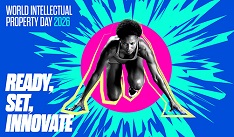
A WIPO campaign poster for this year’s World Intellectual Property Day.
“IP and sport”: Under this banner, the World Intellectual Property Organisation (WIPO) and patent and trade mark offices around the world are highlighting the importance of intellectual property rights.
An article on our website demonstrates how sport serves as a springboard for innovation. Technical developments play a particularly significant role in (para)sport. Technical innovations such as prosthetics, wheelchairs and signalling devices help people affected by accidents, illnesses or physical disabilities to compete in competitive sport at the highest level. Just a few decades ago, Paralympians competed wearing their everyday prostheses. It is only since the 1980s that specialised sports prostheses have been available, and their development has been steadily advancing ever since. High-tech sports prostheses, wheelchairs, exoskeletons, training equipment and orthoses – you’ll find some prime examples in our article.
Innovation trend: A wealth of inventions for strength training equipment
The development and improvement of sports and training equipment is also, in general, an important and ongoing area of activity for inventors. Last year, the DPMA received 479 patent applications in the two most relevant patent classes (A63B and A63C). That is almost exactly the same number as ten years ago (480). Just under a fifth of these were filed by German applicants. A key focus is on strength training equipment of the kind used in gyms. Ninety-three inventions were classified under the relevant main group (A63B/21) – roughly double the number over the past 20 years.
The DPMA in Munich’s Werksviertel: basketball, jazz and intellectual property
Staying on top of intellectual property protection: On Thursday 23 April, from 11 am to 3 pm at Knödelplatz in Munich’s Werksviertel, the German Patent and Trade Mark Office will be providing information on, among other things, the benefits of patents, trade marks, utility models and designs, as well as copyright. “The protection of intellectual property is a key strategic tool for our country’s future viability: it fosters solutions to major societal challenges, strengthens the economy’s competitiveness and supports growth and prosperity,” emphasises DPMA President Eva Schewior. The DPMA Jazz Combo will be providing the music at the stand. And all passers-by will have the chance to try their luck at shooting hoops to the beat of the music. On the edge of Munich’s Werksviertel district stands the new headquarters of the German Patent and Trade Mark Office, where patent examiners also examine the latest technical inventions relating to both professional and amateur sport.
Jazz, Basketball & Fair Play: The video of our information stand in the Werksviertel
Youtube content
This video is provided via the Youtube video platform. If you use services of this provider, it may be that usage data is collected and possibly stored in server logs.
The German Patent and Trade Mark Office has no influence on the type and scope of the transmitted or stored data.
For more information on the data collected by Youtube, its storage and use, please refer to the
Privacy Policy of the provider.
The German Patent and Trade Mark Office
Inventiveness and creativity need effective protection. The DPMA is the German centre of expertise for all intellectual property rights – patents, utility models, trade marks and designs. As the largest national patent office in Europe and the sixth largest national patent office in the world, our office stands for the future of Germany as a country of inventors in a globalised economy. Its staff of around 2,800 at three locations – Munich, Jena and Berlin – provide services to inventors and companies. They implement federal innovation strategies and develop the national, European and international protection systems.
Pictures: gettyimages/Edwin Leung, WIPO
Last updated: 22 April 2026
Not only protecting innovations
Social Media