
Overview Development and origin of trade mark applications
In 2025, the DPMA saw a significant increase in trade mark applications. In total, we received 96,328 trade mark applications, up 19.8% compared to the previous year (80,376 applications). National applications even rose by 20.8% — from 77,224 to 93,291 —, whereas the requests for protection in Germany based on international registrations of marks decreased by 3.6%, from 3,152 to 3,037.
One of the main reasons for the rise is the rapidly grown demand from China. In 2025, we received 10,027 applications from China, an increase of 196.2% on the previous year (3,385 applications). Applications from the USA also rose considerably, from 549 to 1,103 (+100.9%). For one thing, this shows a strong interest in being present in the German market. For another, the fact that large online marketplaces offer vendors with an officially registered trade mark advantages over and leverage against third parties may also play a crucial role. That likely also triggered the considerable increase in applications from Germany (+12%), with domestic applicants accounting for the majority (around 84%) of applications at the DPMA.
However, the possibility of preventing third parties from using protected trade marks on marketplaces also attracts bad-faith users, who try to file trade marks that are not their own with the DPMA. The best way to avoid this is an early registration of one’s own trade marks, as many applicants have obviously done. Our examiners are aware of this issue and, when examining trade mark applications, pay particular attention to identifying bad-faith applications early and to preventing market obstacles.
At the European Union Intellectual Property Office (EUIPO), applications from China also increased significantly, from 27,589 applications in 2024 to 31,306 applications in 2025 (+13.5%). The increase was less significant than at our office, but started from a higher base. Nonetheless, compared to the development of the total of EU trade mark applications at the EUIPO (from 180,512 applications to 196,957 applications, +9.1%), it was above average. German applications at the EUIPO also experienced an above-average increase, from 21,930 applications in 2024 to 24,960 applications in 2025 (+13.8%).
With respect to the classes most frequently applied for, the ranking remained unchanged from the previous years. Indicated in 30,757 applications, class 35 (advertising; business management, organisation and administration; office functions) was the class most frequently indicated. It was followed by class 41 (providing of training; entertainment; sporting and cultural activities), which was indicated in 24,679 applications. Class 9 (electrical apparatus and instruments; computer hardware; software; optical apparatus and instruments), which was indicated in 20,823 applications, came in third.
It is remarkable that the increases were disproportionately high in all three classes. The growth rate of classes 35 and 41 was 28.4%, that of class 9 even 38.9%. The latter rate is probably due to the rise in applications from China, since many Chinese applicants offer electrical goods.
Top 51 Classes2 of goods and services
2 A trade mark application can be attributed to several classes.
In 2025, most applications came from North Rhine-Westphalia (24,499). In relation to the population, North Rhine-Westphalia also did very well and came in third with 136 applications per 100,000 population, behind the city states of Hamburg (185 applications per 100,000 population) and Berlin (144 applications per 100,000 population). Among the territorial states, Bavaria took second place in absolute numbers (12,316 applications) and fourth place in relation to the population (93 applications per 100,000 population).
In the 2025 ranking, Sunday Natural Products GmbH tops the list with 47 registrations, followed by adRock Media FZCO with 45 registrations and Lippische Consulting und Beteiligungen GmbH with 43 registrations.
In 2025, 55,863 trade marks were registered, which represents an increase of 11.7% on the previous year (50,016 registrations). On the other hand, there were 18,982 withdrawals and 7,503 refusals. This means that most applications result in a registration: fewer than 10% of the trade marks are refused due to substantive or formal grounds for refusal. As a result of the high application numbers, pending procedures rose from 29,024 at the end of 2024 to 39,886 at the end of 2025, so we were not able to conclude all procedures as quickly as usual.
Since the introduction of the certification mark, the filing behaviour concerning collective and certification marks has changed a lot. While in 2019 there were 146 collective mark applications and 60 certification mark applications, in 2025 there were only 40 applications for a collective mark and as many as 154 applications for a certification mark. But many applicants misunderstand the purpose of a certification mark — although precise information is provided in the digital filing procedures (DPMAdirektWeb and DPMAdirektPro) and on the paper form. Unlike a normal trade mark, which the proprietor uses as the name for their products, a certification mark certifies a certain quality of the products. It is not used by its proprietor, who only carries out the quality test, but by persons who want to highlight the quality of their goods and services. A certification mark can fulfil this specific function only if it indicates somehow that a test has been conducted in this regard and certain characteristics are certified.
| Selected data | 2021 | 2022 | 2023 | 2024 | 2025 |
|---|---|---|---|---|---|
| New applications | 87,649 | 73,312 | 75,261 | 77,224 | 93,291 |
| Registrations | 68,644 | 53,643 | 48,699 | 50,016 | 55,863 |
| Refusals | 9,634 | 7,793 | 6,629 | 7,343 | 7,503 |
In the fifth year after the amendment of the legal provisions on revocation and invalidity proceedings, there was a considerable increase in related applications received by the DPMA. While it has been possible to request the cancellation of a trade mark due to absolute grounds for refusal since the entry into force of the Trade Mark Act (Markengesetz) in 1995, a declaration of invalidity (because of the existence of earlier rights) or revocation (for non-use) had to be claimed in court for a long time. Since 1 May 2020, there has been the option to file an application for revocation and a declaration of invalidity with the DPMA and have the proceedings conducted at the DPMA. In 2025, the office received 155 applications for a declaration of invalidity because of the existence of earlier rights (previous year: 102) and 409 applications for revocation intended to obtain a substantive decision (previous year: 320). In addition, 151 applications for a declaration of invalidity because of absolute grounds for refusal were filed (previous year: 149), 72 of which concerned the ground for refusal that a trade mark had been filed in bad faith (previous year: 68).
In particular, applications for revocation prove the attractiveness of the amended legal provisions. While court proceedings involve the risk of high costs, the cost-saving proceedings at the DPMA usually eliminate the cost risk because both parties bear their own costs.
At the Jena location, around 40 staff of the trade mark administration deal with secondary procedures after the definitive registration of a trade mark. In particular, secondary procedures include renewals, the recording of changes, restrictions on disposal, divisions, licensing procedures and cancellations. Other horizontal tasks the trade mark administration staff perform are issuing priority documents, certifications of origin and other register extracts as well as providing internal services, for example quality assurance tasks, including corrections of the trade mark register.
At the end of 2025, the register for the first time contained more than 900,000 trade marks, 909,659 trade marks to be precise, which corresponds to a slight increase compared to the previous year (897,771 registrations; +1.3%). With respect to 95,488 trade marks, the parties made changes concerning proprietors, representatives or addresses of service. At 43,957, the number of trade mark cancellations due to the non-renewal of the term of protection, a surrender or an opposition or following the conclusion of revocation or invalidity proceedings was slightly higher than the previous year’s figure (41,033). There was also a slight increase in renewals to 37,418 (2024: 35,891). Furthermore, declarations of willingness to license or sell/transfer continued to gain importance: the DPMA received non-binding declarations of willingness to grant licences from the respective proprietors with respect to 36,184 trade marks (previous year: 31,890); however, a licence was only entered in the register for 25 trade marks. It also received declarations of willingness to sell/transfer with respect to 17,955 trade marks (previous year: 16,072).
For further statistical data on trade mark administration, please see the Statistics chapter.
In focus: Trade mark protection in the digital world Identifying risks and securing rights
Branded products are as important in the digital world as they are offline — but they face increasing pressure there, too. Fake shops, cybersquatting and new AI technologies such as large language models not only offer new opportunities, they can also pose a risk to the protection of trade marks. If you want to effectively protect your trade mark, you need to recognise these dangers and act as early as possible.

The use of Artificial Intelligence (AI) also has its dark sides: AI applications can make our work easier, but they can be used for illicit purposes as well. For example, third parties may use AI to search for trade marks that are already in use on the market but are not yet registered, and then register them in their own name. Such applications are called “applications made in bad faith”. What makes this especially problematic is that many online shopping platforms offer holders of registered IP rights comprehensive tools to exclude others from using a trade mark — even entitled users. Our recommendation: register your own product and monitor the trade mark register to prevent your IP right being abused by third parties.
From fake shops to cybersquatting
Moreover, AI makes it harder to recognise fake shops, which often copy the website of a known producer. They use the same photos and/or texts and thus infringe not only trade mark rights, but also copyrights. In addition, large language models and translation programs make it easier for fraudsters to create a website that looks legitimate. The times where fake shops could easily be spotted by wrong or non-sensical translations are mostly over. One frequent consequence is that consumers never receive the alleged brand products they bought for a seemingly great price.
Another issue related to fake shops is cybersquatting: third parties take advantage of a brand’s good reputation and register domains that have not yet been secured by the actual trade mark proprietor. By doing so, they not only exploit the brand’s reputation to lure users to their fake website, they might also try to sell the domains to the trade mark proprietor for a large amount of money. Registering domains containing your trade marks as early as possible (around the time of the trade mark application) helps to prevent cybersquatting.
New technology — new opportunities to enforce your rights
But we should not forget that new technological possibilities also offer a lot of great opportunities, such as enabling us to prove the authenticity of goods in a tamper-resistant way, for example via certificates saved in a blockchain (non-fungible tokens, NFTs). Software, too, can help with monitoring the market by automatically detecting and reporting products that infringe your sign on an e-commerce platform.
For more information on effective trade mark protection, please visit our website.
In addition, you can find an anti-counterfeiting and anti-piracy technology guide on the website of the European Union Intellectual Property Office.
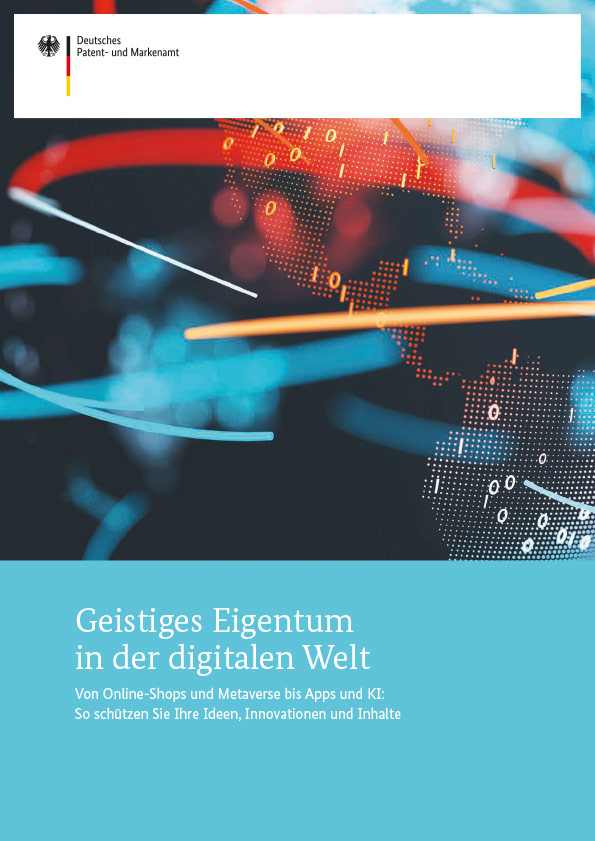
The digital world does not only pose challenges to trade mark protection — patents, utility models, designs and copyright need to be defended as well. The DPMA wants to raise more awareness for this topic among rightholders: whether online shops, apps, 3D printing or AI — our new brochure “IP in the digital world” gives you on overview of how you can effectively protect your ideas, innovations and content in the digital world with patents, trade marks, utility models and designs. So far, the brochure is only available in German (PDF). An English version will be available soon.
Briefly explained: Nice Classification Sorting the colourful world of trade marks
Nougat, nail polish and neuromorphic engineering — the world of trade marks and services is as colourful as it is big. The “Nice Classification” provides an international classification system for categorising goods and services in trade mark applications. On 1 January 2026, a new version came into force.

From a legal point of view, a trade mark is a sign that identifies a provider’s goods and services and distinguishes them from those of other companies. Thus, the application for the registration of a trade mark requires at least one applicant, a sign and the designation of the goods and/or services for which the trade mark is filed. If all this information is provided with sufficient clarity, the trade mark can claim seniority (this is important, since the trade mark that was registered earlier takes precedence over the later trade mark).
The goods and/or services indicated in the application define which field, meaning which class of goods or services, the subject of protection for which the trade mark was filed belongs to. The trade mark is only protected in the classes of goods and/or services applied for and can only defend itself against similar trade marks with less seniority that are from the same field. For example, the trade mark “Hansmayer”, which is protected in the category “sandwiches; food and drink catering”, could not successfully take legal action against the trade mark “Hansmayer” for “clothing for sports”.
Goods and services for which trade marks can be applied for cover all tradeable goods — so there is an almost infinite number of terms. To create a uniform and clear structure, the contracting states established the “Nice Agreement Concerning the International Classification of Goods and Services for the Purposes of the Registration of Marks” at the Nice Diplomatic Conference in 1957. This “Nice Classification” offers a classification system that categorises all conceivable goods and services into 45 classes. 34 of those refer to goods, the other 11 to services. Based on concrete terms and especially headings, the Nice Classification assigns all goods and services to a certain class. Germany ratified the Classification in 1962.
For applicants, this mainly matters in regard to the fees to be paid. The basic application fee of 290 euros (for an electronic application, otherwise 300 euros) includes three classes of goods or services. For each additional class, applicants need to pay another 100 euros. The more comprehensive the protection, the more expensive the application. This pattern continues with the renewal of the trade mark’s term of protection after 10 years. Therefore, applicants should carefully consider which classes of goods and services they really need and then also make good use of them.
When it comes to international cooperation, the classification provides participating trade mark offices with a quick overview of the subject of protection of a foreign trade mark. For example, if you have a Brazilian trade mark with 150 Portuguese terms in the register, the classification makes it easy to determine in which fields it is protected.
For our office, the Nice Classification also plays an important role for the division of work and assigning the competent persons in charge: They work in teams, each of which is responsible for different classes. When filing an application, applicants should always indicate the focus of their application as the leading class. The leading class then determines which team will process the application. This enables us to process all applications in a specialised and effective way.
In the end, what’s decisive for the subject of protection of a trade mark is the actual term that is used for the goods or services. Even during an examination of the similarity of goods or services due to a trade mark dispute, the classification is not the crucial factor. But it does create a uniform and clear structure and order in the application. This is why it is used in more than 140 countries.
To keep the Nice Classification up-to-date, it is continuously revised and a new edition is usually published every three years. On 1 January 2026, the 13th edition of the Nice Classification came into force. For an overview of all current lists of classes for goods and services as well as further information regarding your trade mark application, please go to our webpages.