
Overview National cooperation projects

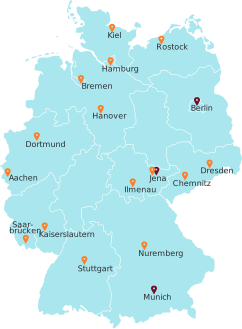
Locations of the German Patent and Trade Mark Office
The protection of intellectual property often starts at a local level — and this is exactly where the patent information centres (Patentinformationszentren; PIZ) are, the central partner of the German Patent and Trade Mark Office (DPMA). With 15 locations all over Germany and together with the DPMA, they provide an effective and closely aligned consulting network. The PIZ in their role as regional points of contact combine professional expertise with their closeness to the economy and thus greatly contribute to strengthening Germany as a country of innovation. In particular, the PIZ help small and medium-sized enterprises (SMEs), start-ups and people interested in founding their own companies to strategically protect and advance their innovations. They offer individual consultations, thorough searches for patents, trade marks and designs as well as support for developing suitable IP strategies. The PIZ are a neutral and professional point of contact that helps people gain a better overall understanding, recognise opportunities and avoid risks. The close and confidential cooperation between the DPMA and the patent information centres ensures that knowledge and support are provided exactly where they are needed: directly to the innovators. Together, we contribute to raising awareness for the value of IP rights and to establishing easy access to the protection of innovation. And this strong partnership will continue to be a central component of our commitment for innovation and competitiveness in Germany.
The German-wide PIZnet Action Week has become an annual key event for many small and medium-sized businesses. In 2025, for one week, the PIZ once more offered free, confidential and neutral initial consultations regarding the protection and strategical use of IP rights. This offer in particular targets SMEs, start-ups and people interested in founding their own company who want to protect their ideas, take advantage of their innovative potential and identify economic risks early on. In individual talks, the consultants analyse a company’s IP situation and point out possible options. The high demand and the participants’ positive feedback prove the great value of this format. During the PIZnet Action Week 2025, the patent information centres held 40 consultations with SMEs — this corresponds to around 72 hours full of know-how, practical expertise and individual support. But not only the numbers show the format’s success: when asked if the consultation offer met their expectations, the participants’ average rating was an excellent average of 4.76 on a scale of 1 to 5. Each of the SMEs surveyed would also recommend the offer.
The German Patent and Trade Mark Office supports the PIZnet Action Week together with the patent information centres and welcomes the positive reception. The Action Week raises companies’ awareness of the strategic use of IP rights and helps them secure their innovative strength – and it will continue to do so in 2026!
In her welcome speech, DPMA President Eva Schewior emphasised the central role of the partnership between the patent information centres and the DPMA for Germany as a country of innovation. In view of various economic developments, she said, it was crucial to translate the potential of research and development even more consistently into protected innovations. The exchange at the PIZ Conference, she added, contributed essentially to helping regional IP service providers connect with the DPMA and to advancing the strategic cooperation.
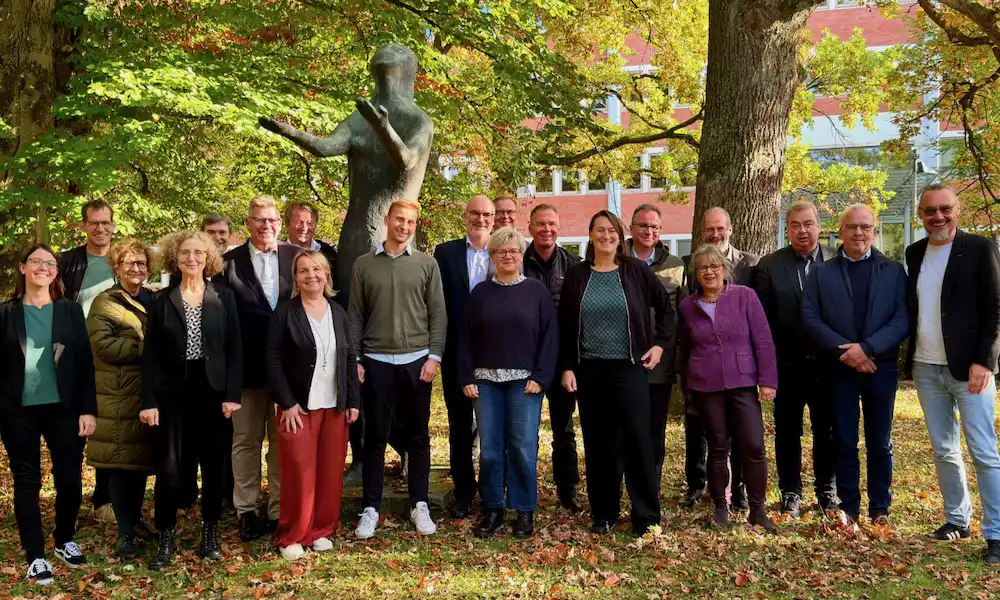
Besides the current developments at the DPMA, the focus was mostly on topics regarding the future, among them the development of new approaches to support SMEs as well as the knowledge transfer at institutions of higher education. In this area especially the patent information centres play a key role, as they have become a regional convergence point for science, economy and the IP system. The participants also presented specific cooperation projects, such as joint event formats and the roadshow initiative, and worked on advancing them. These help to raise awareness for the strategic management of IP rights among companies, start-ups and research institutions in particular and to facilitate the access to information about IP.
The PIZ Conference 2025 once more showed that the grown partnership between the DPMA and the patent information centres provides a solid foundation for promoting innovation and technology transfer.
The protection of IP rights can only reach its full potential if it is consistently enforced and all involved stakeholders work closely together. Besides the successful cooperation with the patent information centres, the DPMA also focused on extending the collaboration with additional key partners in 2025. It´s our goal to strengthen the enforcement of IP rights, to effectively combat product and trade mark piracy and to raise long-term awareness for the value of intellectual property.
Among our most important partners is German customs, especially the Central Industrial Property Office of the Customs Criminological Office. As key operational body in combatting counterfeits, customs authorities confiscated fake goods worth 417 million euros in 2024 alone. Thanks to the close exchange of expertise, the DPMA supports the authorities in charge with its IP know-how and contributes to efficiently accompanying and advancing measures for enforcing legal rights. The DPMA has also intensified the cooperation with trade fair companies and initiatives for raising awareness among the public and industry. For example, the DPMA was at the international consumer goods trade fair “Ambiente 2025” in Frankfurt am Main together with Aktion Plagiarius. On 6 February 2026, at the fair, Aktion Plagiarius e.V. for the 50th time awarded the anti-prize “Plagiarius”, which turns the spotlight on the producers and distributors of particularly audacious product counterfeits and thus increases the awareness for the importance of intellectual property. At the joint booth, the DPMA informed about the various options to protect innovations and illustrated the economic and social consequences of counterfeits. Such collaborations significantly contribute to strengthening prevention and the use of IP rights in industry and society. In addition, the DPMA as a central networking partner strategically brings together authorities and institutions that are involved in the enforcement of IP rights. At the network meeting “IP Awareness and Enforcement”, which took place for the third time in November 2025 and was hosted by the DPMA in Munich, the representatives of investigative and law enforcement authorities, prosecutor’s offices, state criminal police offices and market surveillance authorities discussed current challenges they are facing. At expert events, the DPMA also offered practical know-how about the legal prosecution of IP infringements, thereby strengthening cooperation and enhancing the confidence of the institutions involved in taking action.
These numerous collaborations illustrate the DPMA’s key role within the network of law enforcement. As centre of expertise for IP rights, the office strategically applies its expert skills, supports the exchange between institutions and significantly contributes to efficiently combatting product and trade mark piracy as well as protecting innovation and competition in Germany.
Interview with Steffi Jann, head of the patent and trade mark centre Schleswig-Holstein “We must think more strategically about protecting intellectual property”
The head of the patent and trade mark centre Schleswig-Holstein, Steffi Jann, draws attention to the attractive PIZ services for small and medium-sized enterprises as well as start-ups, praises the successful cooperation with the German Patent and Trade Mark Office and explains why there should be an even greater focus on IP protection in Germany.

A survey published by the European Union Intellectual Property Office (EUIPO) reveals that Europe-wide, just about ten percent of SMEs make use of patents, utility models, trade marks or designs. However, IP protection is a key factor for the success of small and medium-sized enterprises.
As far as our experience goes, it is not due to a lack of innovativeness of SMEs, but rather owing to structural and practical barriers. The greatest obstacles are costs, complexity and a lack of internal know-how; in addition, there are uncertainties about the actual commercial benefit and doubts concerning the enforceability vis-à-vis larger competitors.
Many start-ups and SMEs don’t know which IP right comes into question, when the best time for applying is, how the filing process works and how IP rights can be used strategically. They don’t have a patent division entrusted with these issues which provides structured support for innovation processes and which secures inventions worth protecting. Decision-makers often concentrate on the operative core business; for developing and pursuing an IP strategy, however, a long-term perspective is required. Yet there is support for enterprises. However, due to the high workload of the persons in charge, the information and advice services of patent information centres (PIZ), most of which are available free of charge, are not made sufficient use of.
You have many years of experience in advising on intellectual property. Has awareness of the importance of IP rights changed over the last years?
Yes, that’s the impression I get. Our advisory work shows us that IP awareness has diminished in many companies. The world has become more complex — new technologies and shorter innovation cycles, new markets, new legal requirements —, in general and of course also in the field of IP. However, there is neither more time nor more money nor more staff available. IP is not a simple topic. Due to the complexity of the task and the related costs it is often neglected for the sake of other prioritised issues and duties. Demographic change also plays a role. Experienced staff are retiring, leaving behind large gaps, especially a lack of knowledge in the field of IP management. In addition, there is a shortage of young academics coming from universities that have of a deep understanding of intellectual property as an economic factor of success, because this topic is unfortunately neglected in their training. Owing to such developments, the great strategic importance of IP rights fades into the background.
How problematic is this?
We, the patent information centres, are following this development with great concern. Especially because we see a development in the opposite direction in international competition: countries such as China consider IP rights as a key strategic instrument. This increasing pressure of competition, which also utilises IP rights, can’t be ignored by the numerous innovative SMEs in Germany. There is no getting around protecting one’s own innovations with IP rights. Nevertheless, in many companies, leading developers have to work hard to convince their management to grant personnel and a budget for this purpose. In our working groups, there are more and more discussions about how to better explain the relevance of IP within the companies.
What else can we do?
We have to raise awareness of intellectual property and the benefits of IP rights among the people. I deliberately put it like this, as it should be obvious: after all, IP rights are rights that have to be respected by everybody — and their infringement can cause high costs.
In order for this to become a normality and for the economic relevance to be communicated adequately, a clear positioning is required: a national IP strategy that outlines the goal, sets priorities, defines specific measures and provides financial support for them. Without such a political sign, it is hard for everyone involved to place greater emphasis on the protection of innovations.
Which services does your PIZ provide?
PIZ Kiel belongs to a strong institution. As part of WTSH GmbH, we benefit from close collaboration with our colleagues, particularly from those working in the field of innovation consulting and the technology clusters. We are entrusted with the task to inform founders, start-ups and SMEs about the importance of IP and to help them to effectively protect IP rights. Specifically, this means that we carry out searches for our customers in patent, trade mark and design databases, provide statistical analyses concerning patents and provide support for developing a suitable IP strategy. Moreover, we help enterprises to systematically keep an eye on relevant technologies and competitors. In addition, we offer specialised events, training sessions and consultation days, both for companies and for the general public. In a nutshell, we do not only see us as a service provider, but also as a partner of enterprises. It is our goal to empower them to successfully use the most important resource of our country: creative and innovative ideas.
How does the DPMA support your work?
For about 20 years now, we have been enjoying a successful cooperation showing positive results on many levels. The PIZ act as a regional point of contact in their respective German Länder: we provide information, raise awareness for IP rights and, at some locations, we act as receiving office. The DPMA, in turn, refers customers to the nearest PIZ via its Customer Care and Services and other public relations activities. This way, PIZ Kiel is able to support companies based in Schleswig-Holstein in a direct and uncomplicated way.
The professional exchange with the DPMA is particularly valuable: for example, the PIZ benefit from trainings by patent examiners — we are visited by experts for our seminars, and we receive support securing funds for SMEs, which the DPMA raises for us on a European level.
In the field of marketing, we are also strongly connected; the DPMA advertises central formats such as the yearly PIZnet Action Week — in 2025 with the motto “IP strategies for SMEs” — and it makes visible the PIZ services via its website and social media channels.
Last but not least, I would like to mention that the PIZ are an important user group which is represented in the DPMAnutzerbeirat. The direct exchange and networking with other relevant IP actors in this committee is extremely enriching.