The EU has extended the uniform protection previously offered only to wine, spirit drinks and agricultural products (Agricultural Geographical Indications, AGRI-GIs) to cover craft and industrial products (Craft and Industrial Geographical Indications, CIGIs). As of 1 December 2025, the names of such products can be protected by their central, EU-wide registration as geographical indications. This IP right is based on Regulation (EU) 2023/2411 and the German implementing provisions in sections 129a to 136 of the Trade Mark Act.
The IP right registers the names of products originating in a specific geographical area whose quality, reputation or other characteristics are essentially attributable to their particular origin. At least one production step must take place within this geographical area.
All products that are manufactured by hand or in a standardised way and by using machines can be protected. This includes, among others, clocks, cutlery, fabrics, porcelain, woodwork, jewellery, textiles, natural stones and glass. In the view of the EU, potential products can range from wooden art from the Ore Mountains to Jena glass and Mittenwald violins to ties from Krefeld or ball bearings from Schweinfurt. You can find a list of products from many German regions on the webpages of the European Union Intellectual Property Office (EUIPO).
Applications can be submitted electronically to the DPMA via the GIportal of the EUIPO. To submit an application in writing, please use application form W 7007 from our website. The processes for receiving submissions and other relevant processes in the DPMA’s IT environment have been adapted to enable the fully electronic processing of the relevant documents and data as well as the management of the specific processes.
The examination procedure has two phases: in the national phase, the DPMA examines the application, manages the national opposition procedure, if any, and, following the positive completion of the examination, submits the application to the EUIPO. In the second phase, the EUIPO continues the procedure at Union level and finally decides on the registration. For more information, please visit the website of the EUIPO. The names of craft and industrial products for which the registration as a geographical indication has been applied for or which are already registered as geographical indications can be found in the electronic Union register of the EUIPO. In addition, you can find detailed information in the search database DPMAregister already during the processing of the application at the DPMA.
For more information about the new IP right and how to apply for it, please visit our website.
The DPMA has transferred its responsibility for applications regarding AGRI-GIs pursuant to Regulation (EU) 2024/1143 (formerly Regulation (EU) No. 1151/2012) at national level to the Federal Office for Agriculture and Food (BLE). As of 16 January 2026, all new applications and requests regarding ARGI-GIs — i.e. applications for registering a protected indication and for amending the product specification, requests for cancelling a protected indication as well as cross-national oppositions — have to be submitted to the BLE.
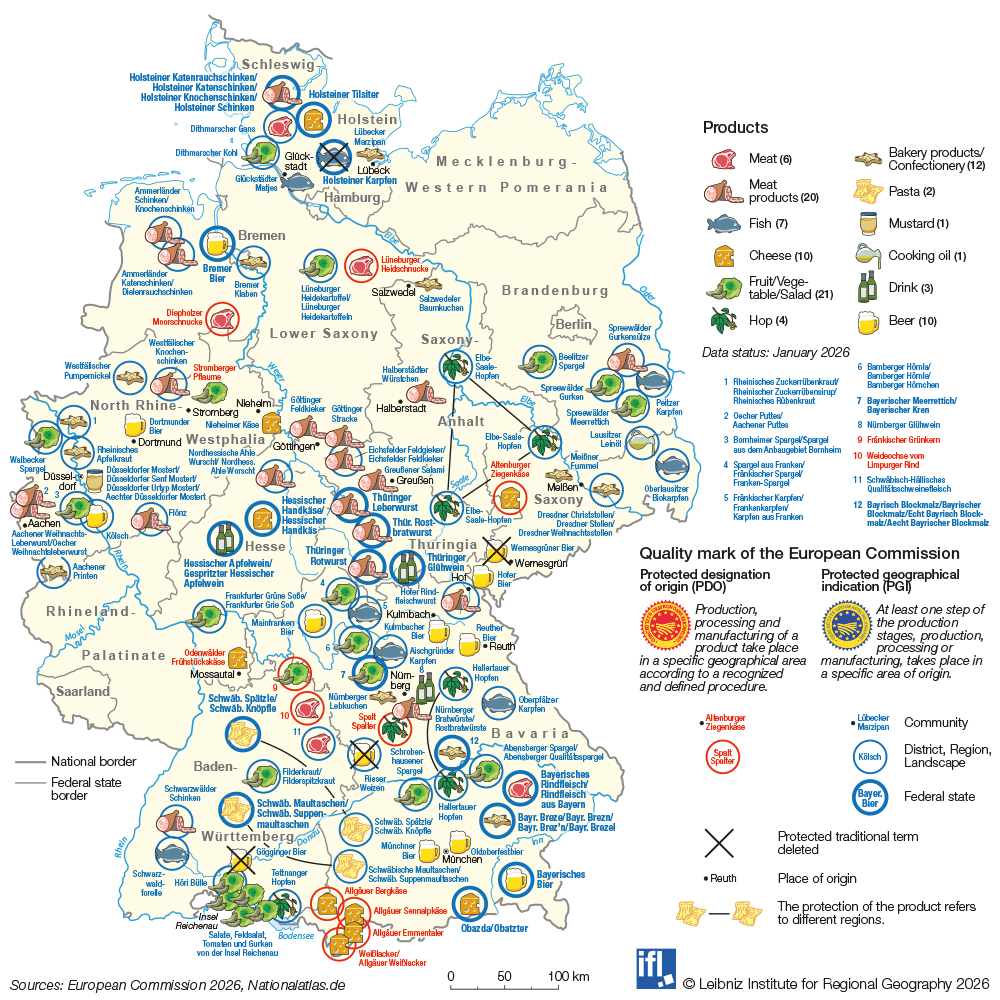
In 2025, the DPMA received a new application for the registration of the designation “Nürnberger Rotbier” (Nuremberg red beer) as protected geographical indication (PGI). For the PGI “Bayerisches Bier” (Bavarian beer), an application for amending the product specification was submitted. For the PGI “Meißner Fummel” (a hollow pastry), a request for cancellation was filed; the request for cancellation regarding the PGI “Salzwedeler Baumkuchen” (cake from Salzwedel) already pending before the DPMA was withdrawn by the persons who had filed the request.
After the positive completion of the examination, the DPMA forwarded the application for protection of the PGI “Witzenhäuser Kirschen” (cherries from Witzenhausen) to the European Commission for the final examination. In the amendment procedure regarding the PGIs “Abensberger Spargel” (asparagus from Abensberg) and “Schrobenhausener Spargel” (asparagus from Schrobenhausen), the DPMA approved the requested standard amendments.
Food with protected geographical status