Although the economic situation in 2025 continued to be difficult, designs once again had a good year. Compared to the previous year, the number of design applications filed with the DPMA in 2025 considerably increased for the second year in a row, to 4,183 (+5.9%). After the constant decline in design applications in the previous years, this might be a sign of a reversal of the trend.
Applicants once again made extensive use of the option to combine several designs in a multiple application. It is possible to combine up to a total of 100 designs in multiple applications filed via the DPMAdirektPro software or on paper. The web-based filing platform DPMAdirektWeb allows multiple applications comprising up to 20 designs to be filed. In 2025, two-thirds of applicants (66.5%) took advantage of this service.
In 2025, applicants filed, on average, 10.2 designs in a multiple application. In total, the DPMA received 29,687 designs filings.
Last year, we were able to conclusively process requests for entry in the register for a total of 27,161 designs. The time needed by the Design Unit until registration was about three months. We entered 25,377 designs in the design register; this means that the percentage of positive completions was 93.4% (2024: 91.4%).
At the end of 2025, 226,960 designs were registered at the DPMA, that is 4.8% fewer than in the previous year.
Last year, with 95.1%, most of the designs registered at the DPMA once again came from Germany (which means from holders having their residence or principal place of business in Germany). Thus, the proportion of design registrations from abroad decreased slightly compared to the previous year. A total of 727 registered designs came from other European countries (2024: 1,376), 517 from non-European countries (2024: 681). In 2025, the majority of designs registered from abroad originated from China (286), followed by Austria with 264 registered designs.
| countries of origin | Registered designs | Percentage |
|---|---|---|
| Germany | 24,133 | 95.1 |
| China | 286 | 1.1 |
| Austria | 264 | 1.0 |
| Czech Republic | 164 | 0.6 |
| Switzerland | 88 | 0.3 |
| USA | 71 | 0.3 |
| United Kingdom | 59 | 0.2 |
| Japan | 56 | 0.2 |
| Taiwan | 49 | 0.2 |
| Poland | 44 | 0.2 |
| Others | 163 | 0.6 |
| Total | 25,377 | 100 |
With 27.5%, most of the 24,133 domestic designs registered in 2025 came from North Rhine-Westphalia (6,642 registered designs). This means that North Rhine-Westphalia has now been at the top of the list of German Länder for more than 15 years. In 2025, it was followed by Baden-Württemberg with 3,964 registered designs (16.4%), just ahead of Bavaria with 3,379 registered designs (14%).
In 2025, most designs (4,756, which is 15.9%) were registered in class 6 (furnishing). Class 2 (articles of clothing and haberdashery) was second with 11.5% (3,443 designs), with class 32 (graphic symbols and logos, surface patterns, ornamentation, arrangement of interiors and exteriors) again in third place with 10.4% (3,090 designs). In some classes, there was a trend towards increased application numbers concerning intermediate products of 3D-printed products.
Top 5 Classes of goods of registered designs1 at the DPMA in 2025
Classes of goods of registered designs1 at the DPMA2 in 2025
1 A design can be attributed to several classes of goods.
A registered design may enjoy protection for a maximum period of 25 years, starting from the date of filing. During that period, various procedures can lead to changes in the register entry:
- Renewal or cancellation
A term of protection corresponds to five years. Renewal fees must be paid at the end of each term to renew protection. Otherwise, design protection will lapse. A corresponding comment concerning the registered design will then be made in the register. - Extension
If a design has initially only been registered for a 30-month period of protection from the filing or priority date, deferring the publication of the representation, the holder may pay a fee to extend the period of protection to the first five years after the filing date. In this case, we will make a comment concerning the extension in the design register and publish the reproductions of the design. - Recording of changes
We will record a change to an IP right in the register if, for example, it is transferred from the owner to another person or if there is a change of representative.
In 2025, 26 applications for determination or declaration of invalidity were filed (2024: 22). We will serve the application for determination or declaration of invalidity on the holder of the challenged design after receipt of a fee of 300 euros and examination of further admissibility requirements. If the application is not contested within one month, the Design Division will determine, by decision and without further substantive examination, invalidity and cancel the design in question from the design register after the decision has become final. If the application is contested in due time, the Design Division will conduct an official examination of the submitted grounds of invalidity (the appearance of the product does not constitute a design, lack of novelty or individual character; exclusion from design protection; conflicting earlier rights). Subsequently, the Design Division will make a decision in proceedings that — also with regard to the costs to be borne — are essentially based on the Code of Civil Procedure (Zivilprozessordnung). In 2025, a total of 22 design invalidity proceedings were concluded (2024: 34).
Perspective: Dr. Henning Hartwig, Attorney-at-Law Design law and copyright law — rivals or sisters?
The protection of creative works is an important element of our legal system and encourages innovation. Especially with respect to product designs, creative people have the right to exclusively market their work and to prohibit any unauthorised use. In addition to design protection, copyright law may also apply. In this respect, a decision of the European Court of Justice (ECJ) recently caused a radical change in the interpretation of the law.
Dr. Henning Hartwig is a partner and attorney-at-law at BARDEHLE PAGENBERG in Munich. He has authored numerous publications on European design and copyright law. He is also the editor of the four-volume case law collection Design Protection in Europe (2007, 2008, 2009 and 2012) and the Research Handbook on Design Law (2021).

Like siblings, design law and copyright law are fairly similar. Both fields of law protect the appearance of a product — for example, contours, colours and material. And in both cases, the validity or the “value” of the protected subject matter is not examined in the first instance (this requires a third party), the term of protection is limited (unlike under trade mark law) and the date of creation (copyright law) or the date of filing (design law) is decisive.
As a result of this similarity, legal action is sometimes taken both under design law and under copyright law, as in a case decided on 13 January 2026 by the Brussels Appeal Court with regard to the design of the well-known Longchamp bag “Le Pliage” (2018/AR/957). However, the German practice has always made efforts to make a sufficient distinction in order to avoid double protection. In short: design law and copyright law are siblings, but not twins.
On 4 December 2025, in its ground-breaking decision “Mio/konektra” (C-580/23 and C-795/23), the ECJ basically affirmed this approach. In particular, it established that under copyright law — contrary to a nice hike in the mountains — the journey is not the reward, but that only the result — the “work” — matters. This means that it is not necessary to consider the creative process or what the performer had in mind. Likewise, it is irrelevant for the legal assessment whether famous works of applied art are displayed in renowned venues such as the Museum of Modern Art. Furthermore, as regards the creation of rights, the ECJ emphasises that the conditions for design protection (novelty/individual character) on the one hand and copyright protection (originality) on the other must not be confused.
As regards the enforcement of law, the ECJ clarifies that, unlike under design law, the degree of the creative freedom and the degree of originality are not relevant for the determination of the scope of protection or the establishment of a copyright infringement. In other words, if a subject matter is protected as a work under copyright law, such protection is absolute — this means that a work of applied art is either protected or it is not.
Under design law, however, the protection of a design is relative (high, medium or low level), so there are “strong” and “weak” designs alike. This means that it may be easier for third parties to refute accusations of a design infringement than in the case of a copyrighted work of applied art. Thus, there is still good reason to also file variations in addition to the “basic design” (multiple application) so as to at least hamper product launches of third parties. The graded, degressive fees of the DPMA are an additional incentive.
It remains to be seen how courts will handle the requirements set by the ECJ. Overall, the discussion about the relationship between design law and copyright law is reminiscent of rival siblings or the phrase “same same but different”. Even though both legal instruments have the same origin (protection of product designs), they significantly differ in their specific laws.

100 years ago: Signing of the Hague Agreement From hat fabric to high-tech design
From the first registered hat fabric to iconic industrial and product designs: for a century now, the Hague System has provided for the international protection of designs and thus supported their development over generations.
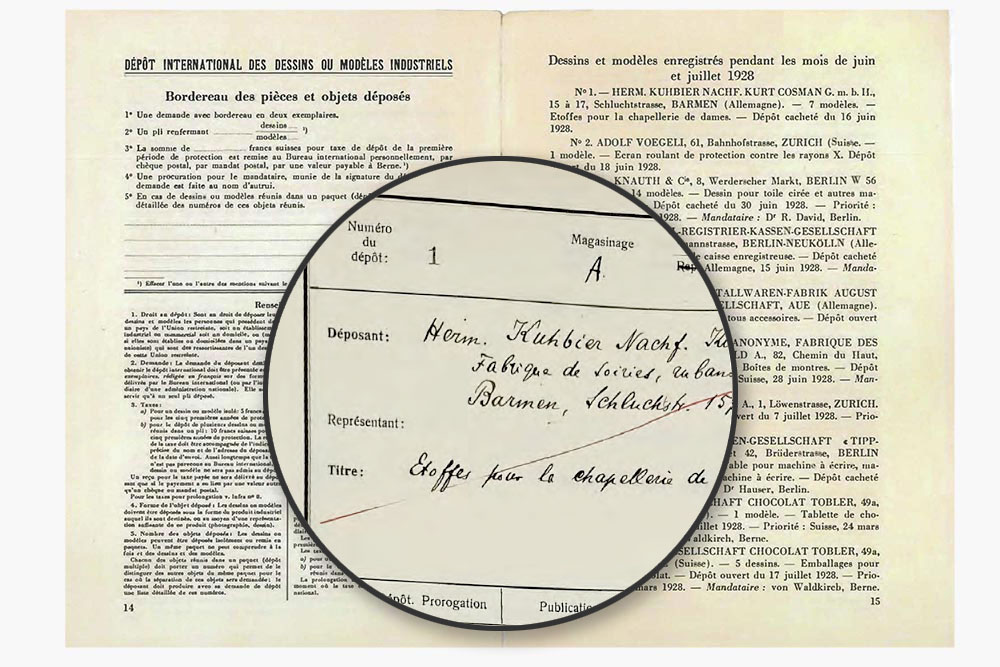
The very first registration came from Germany: Fabrics for ladies’ hats by Herm. Kuhbier Nachf. Kurt Cosman GmbH, Germany, No. 1, 16 June 1928.
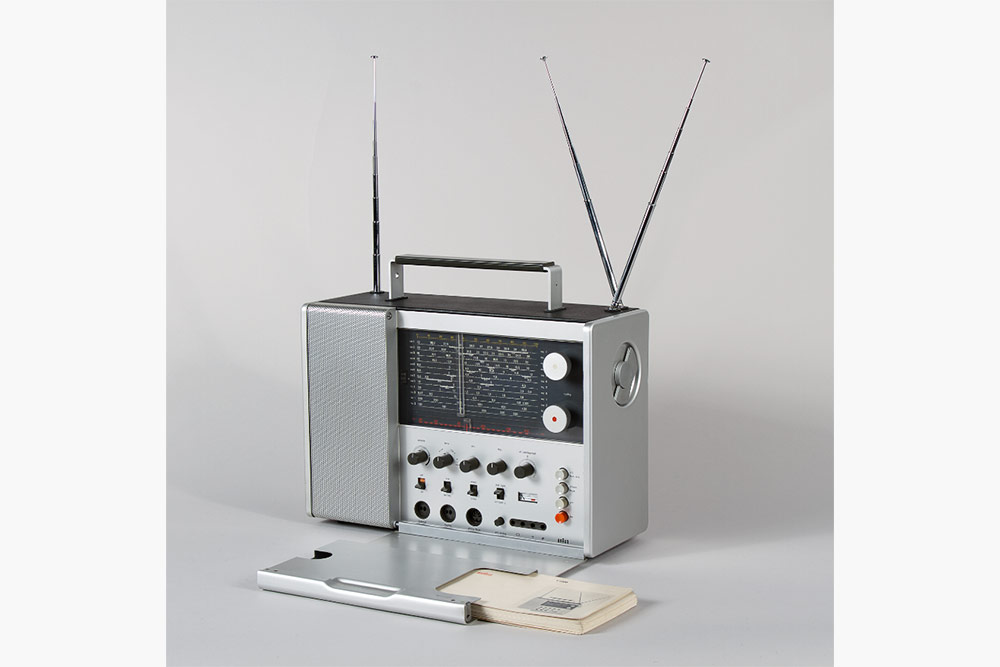
Braun GmbH, Germany, No. 33140, 22 June 1963
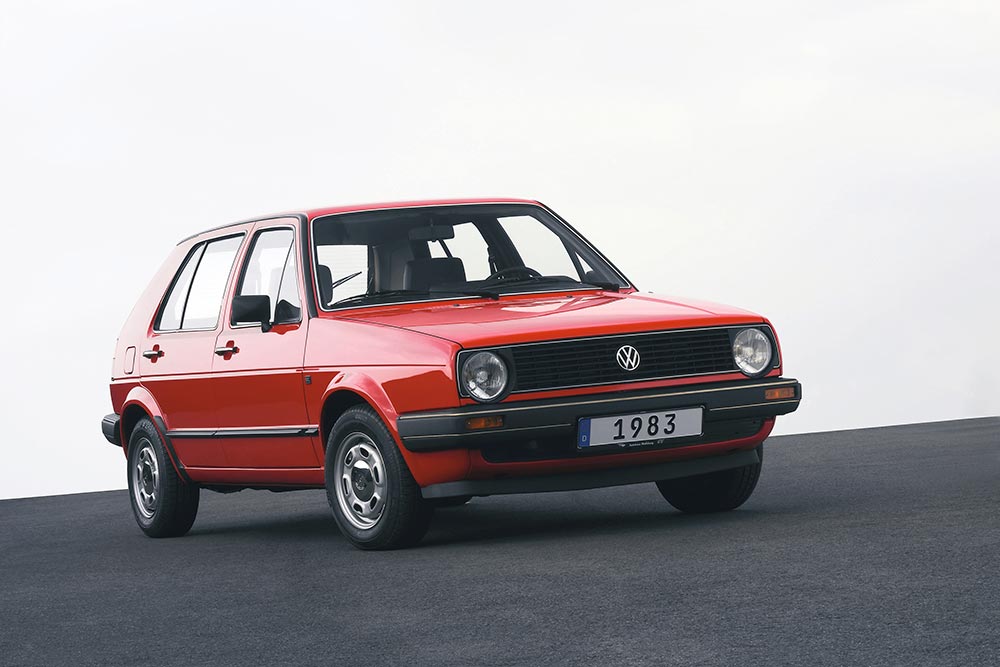
Volkswagen AG, Germany, No. 73726, 6 September 1983
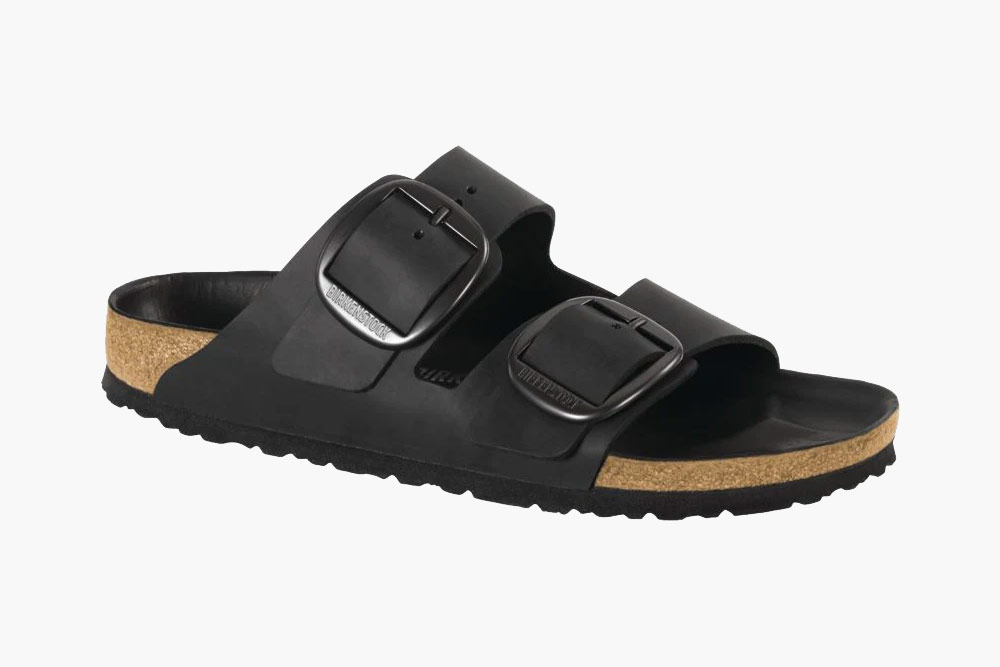
Birkenstock IP GmbH, Germany, No. DM/098 109, 12 October 2017
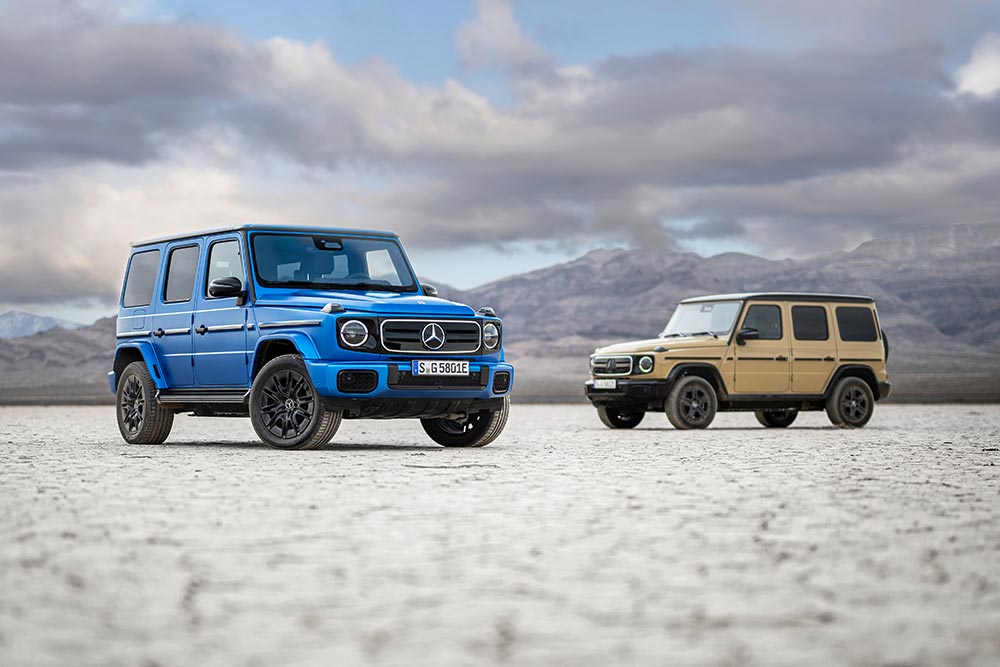
Mercedes-Benz Group AG, Germany, No. DM/225 514, 30 November 2022
6 November 2025 was the 100th anniversary of the signing of the Hague Agreement Concerning the International Deposit of Industrial Designs. The Agreement was adopted in The Hague in 1925. Germany was one of the founding countries. The Agreement marked the beginning of international design protection as a success story that has continued up to the present day.
Design no. 1: fabrics for women’s hats
In 1928, the first registration was documented by the “Bureau international de l’Union pour la propriété industrielle” in Bern — the predecessor of today’s WIPO. It bears the French description “étoffes pour la chapellerie de dames” (fabrics for women’s hats) and was filed by Kurt Cosman from Germany. This registration was the beginning of the new international protection system. Even back then, there was a strong presence of German designers and companies: five of the first ten registered designs originated from Germany.
VW Golf, Playmobil, Birkenstock: many successful German designs
Since then, a number of German designs have shaped the Hague System, which is now open to designers from nearly 100 countries, and set international standards. The PUMA Formstrip represents athletic dynamism and high brand recognition, while the Braun T 1000 World Receiver embodies functional clarity and creative reduction. The Bosch SA12 dishwasher shows how a technical design can easily be integrated into everyday use.
Classics such as the PLAYMOBIL figure, the Volkswagen Golf II or the Birkenstock Arizona Big Buckle illustrate the global impact of German designs. With new innovations — such as the Adidas Al Rihla ball or the all-electric Mercedes-Benz G Class EQ — this tradition continues. These and many more international designs appear in a book published by the World Intellectual Property Organization (WIPO) on the occasion of the anniversary (follow the link in the information box).
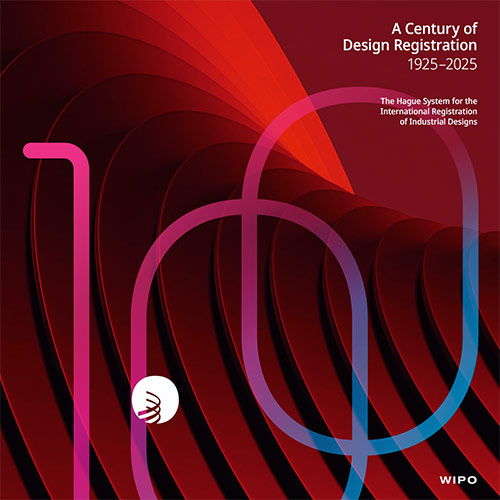
„A Century of Design Registration“
The WIPO publication (PDF) contains 100 fascinating design stories from 100 years of the Hague System for the International Registration of Industrial Designs.