Technical inventions can also be protected by utility models, which offer quick protection for devices and apparatus in particular. Unlike patents, however, the DPMA does not examine utility models for novelty and inventive step prior to registration. Compared to patents, it is often individuals that apply for utility models. Applications by natural persons from Germany played a key role in the strong growth seen last year. Applications from this group rose by just under 47 per cent.
In total, the DPMA received 11,427 utility model applications in the year under review (2024: 9,576), a significant increase of 19.3% compared to the previous year. The share of applications by natural persons rose by approximately 5 percentage points to 39.5%. What was also remarkable was the increase in applications by Chinese companies (+35.9%).
In 2025, “Electrical machinery, apparatus, energy” continued to be by far the most important technology field with 1,480 applications (+31.6%). In the second-strongest technology field, “Furniture, games (other fields)”, 1,036 utility models were filed (+13.1%). As with patents, the technology field “Transport” experienced a moderate increase of 2.4% in utility models, too. Another dynamic technology field was “Medical technology”, which once again rose considerably by 13.9%.
The percentage of electronic filings fell to 67.3%, which corresponds to a decrease by 8.9 percentage points compared to the previous year.
In 2025, a total of 9,750 utility models were registered in the register (+7.6%). This means that 90.0% of the registration procedures handled in 2025 were successfully concluded (previous year: 91.3%).
In total, 1,088 applications were not registered in 2025, for example because of refusals, withdrawals of applications or for other reasons (2024: 859). The term of protection was renewed for a total of 14,984 utility models after payment of the maintenance fee (previous year: 16,146).
A utility model lapses if it is not renewed or the maximum term of protection has expired. The number of lapsed utility models decreased by 10.5% to 10,830.
Thus, at the end of 2025, 62,944 valid utility models were registered at the DPMA (previous year: 64,010).
Top 5 Fields of technology1
Utility model applications in 2025
Applications at the DPMA and PCT applications that have entered the national phase
1 According to WIPO IPC concordance table, available at www.wipo.int/ipstats/en/index.html#resources.
International demand for German utility models remained high. Following the growth seen in the previous year, we recorded a sharp rise in applications from abroad in 2025. Their number rose by 19.2% to 5,163 (2024: 4,333), which corresponds to 45.2% of all utility model applications.
The number of PCT applications in the national phase also increased again, by +21.1% to 517.
In total, 6,264 utility model applications were received from Germany. Thus, the percentage of applications from Germany was 54.8% (previous year: 54.8%).
As in the previous year, most of the foreign applications came from non-European countries (4,148, 2024: 3,345). Applications received from Europe slightly increased by 2.7 percentage points to 1,015.
With a share of 18.9% of all applications, the People’s Republic of China, with 2,157 applications, continues to lead the country ranking for applications from abroad by a clear margin (previous year: 1,620). Chinese companies systematically use utility models to ensure extensive IP rights for product variants and allow themselves strategic room for future innovations and market positioning.
The United States of America took second place with 491 applications (+45.3%), just ahead of India (485 applications). Taiwan was fourth with 413 applications. Among the European countries, the ranking remained unchanged: Switzerland was first with 208 applications, followed by Austria and Italy with 177 applications and 147 applications, respectively.
| countries of origin | Applications | Percentage |
|---|---|---|
| Germany | 6,264 | 54.8 |
| China | 2,157 | 18.9 |
| United States | 491 | 4.3 |
| India | 485 | 4.2 |
| Taiwan | 413 | 3.6 |
| Republic of Korea | 211 | 1.8 |
| Switzerland | 208 | 1.8 |
| Austria | 177 | 1.5 |
| Italy | 147 | 1.3 |
| Japan | 88 | 0.8 |
| Others | 786 | 6.9 |
| Total | 11,427 | 100 |
In 2025, North Rhine-Westphalia once again took first place with 1,616 applications (25.8% of all domestic applications), followed by Bavaria and Baden-Württemberg with 1,280 applications (20.4%) and 1,158 applications (18.5%), respectively. With a considerable 61.5% increase and 491 applications, Hesse came in fourth. In relation to the respective population, Bavaria and Baden-Württemberg shared first place with ten applications per 100,000 population each. North Rhine-Westphalia came in second with nine applications and Hesse third with eight applications.
A split-off utility model is a quick and cost-saving addition to a patent and allows you to protect your innovations against imitation. It serves as a transitional protection option during the pending patent procedure, from filing to grant. Upon registration of the split-off utility model, full protection takes effect – irrespective of whether the patent will be granted at a later date. Furthermore, retroactive protection applies: applicants can use the date of filing of the earlier patent application for the later utility model application. With respect to split-off utility models, too, we saw a significant increase of 18% compared to the previous year (2025: 1,139 split-off utility models, 10% of all utility model applications).
Unlike patents, utility models are simply registered, without an examination of the protection requirements. Therefore, it is much faster and cheaper for applicants to obtain a utility model. But as no examination is conducted, a utility model is less legally secure. Any third party can at any time file a request for the cancellation of a registered utility model. Such a request must be accompanied by a statement of reasons. Applicants can mitigate this risk by filing an early search request with the DPMA. The examining sections will then conduct a comprehensive search for the state of the art that is relevant to evaluate the protectability of the subject matter of the utility model application.
In 2025, we received 1,285 effective search requests (previous year: 1,199). The number of concluded searches decreased slightly to 1,201 (previous year: 1,237).
Cancellation proceedings are an efficient instrument to subsequently clarify the protectability of an initially unexamined utility model. In 2025, the DPMA received 59 new requests for cancellation, which is a small increase on the previous year (56).
A utility model is only cancelled upon request. Anyone can file a cancellation request, even without there being the looming risk of an infringement dispute or an economic interest. A fee of 300 euros is due upon filing the request. The party filing the request and the proprietor of the utility model are then the parties to the cancellation proceedings.
The most frequent reason for cancellation is the lack of protectability. An invention can be protected if it is new compared to the state of the art and involves an inventive step. Other reasons for cancellation include an inadmissible extension of the subject matter, usurpation and existing rights due to earlier patent or utility model applications.
A request for cancellation must provide a sufficient statement of reasons. If, for example, a lack of protectability is submitted as the reason for cancellation, the conflicting prior art should be cited in the request.
The Utility Model Division decides on the request for cancellation. Its panel consists of three persons: a lawyer as the chairperson and two patent examiners specialised in the relevant technological field as reporting and associate judges. As in civil cases, the losing party must usually bear the costs of the proceedings. As in civil cases, the losing party must usually bear the costs of the proceedings.
In most cases, the Utility Model Division makes its decision on the request for cancellation following an oral hearing. Since the spring of 2025, the oral hearings have taken place in our new office building on Anzinger Straße. In six cases, a decision was made in written proceedings without an oral hearing. In two suitable cases, the oral hearing happened by video. In the year under review, 73 proceedings in total were concluded.
In focus: International comparison of utility models Different countries, different protection
Quick protection and moderate costs: whether individuals, small enterprises, start-ups or international groups, utility models are often a good option for them to protect inventions. In Germany, demand for utility models is, once again, increasing considerably. Yet utility models are by no means offered in every country — and the requirements for them differ from one country to the next.
“Coffee filter with a base that is curved and recessed on the underside and with inclined flow holes” — this somewhat cumbersome title describes Melitta Bentz’s famous coffee filter, which is possibly Germany’s most renowned utility model. In 1908, Melitta Bentz, the Dresden-born entrepreneur, applied for protection for her invention with the Imperial Patent Office (Kaiserliches Patentamt). This utility model resulted in a spectacular success story and an international group: Melitta.
At the time, Melitta Bentz obviously appreciated what many inventors, small enterprises and start-ups still need today: a flexible option to protect technical innovations at short notice. But not only small enterprises, large groups too like to use utility models — often as a quick initial form of protection accompanying a patent application, for example as a split-off from a patent application. In combination with patents, utility models have thus become established as an integral part of modern IP strategies. And after some years of declining application numbers, the “little brother” of the patent is once again on the rise: last year, the number of utility model applications at the DPMA increased by 19.3%.
But what has always been part of the IP portfolio in Germany is not a given thing in many other countries, where utility models have another scope of protection or are not available at all. At international level, utility model protection has hardly been harmonised. The attempt to harmonise it in the European Union failed around the turn of the millennium and has not been restarted since.
Utility model protection in Germany considered to be particularly sophisticated
In Germany, utility models are subject to the same requirements as patents: the technical invention must be new, involve an inventive step and be susceptible of industrial application and being carried out. Unlike with patents, however, these requirements are not examined until there are legal disputes with competitors in cancellation or infringement proceedings. In other words, the lack of a substantive examination may result in utility models being less legally valid than patents. Then again, utility models are registered within a few weeks and, upon registration of a utility model, the related invention is protected for a period of up to ten years.
Utility model protection in Germany is considered to be particularly sophisticated; but the picture is different around the world. There is no international treaty on the introduction of a utility model system subject to certain rules. The Agreement on Trade-Related Aspects of Intellectual Property Rights (TRIPS Agreement) does not refer to utility models either. Nevertheless, many countries have created relevant protection systems in order to protect small or incremental technical innovations and provide a flexible complement to the patent system.
A number of developed countries with an Anglo-Saxon legal system — including the USA, the UK, Canada or Australia — do not provide utility model protection. By contrast, many other countries, especially in Europe and Asia, use utility models as a targeted instrument in their innovation policy.
Differences in law around the world
IP rights comparable to utility models differ in their requirements as to the inventive effort and the term of protection. These requirements are often lower than those for patents. There are different terms for the IP rights concerned, such as “utility model”, “utility innovation”, “petty patent” or “innovation patent”. The World Intellectual Property Organization (WIPO) uses the term “utility model”.
In some countries, utility model protection can be obtained only for certain technological sectors and solely for product inventions. For example, technical, chemical or biological processes are sometimes not protectable there. In the case of international PCT applications via WIPO, applicants should consider the respective utility model and patent frameworks in the country in question carefully and on a case-by-case basis.
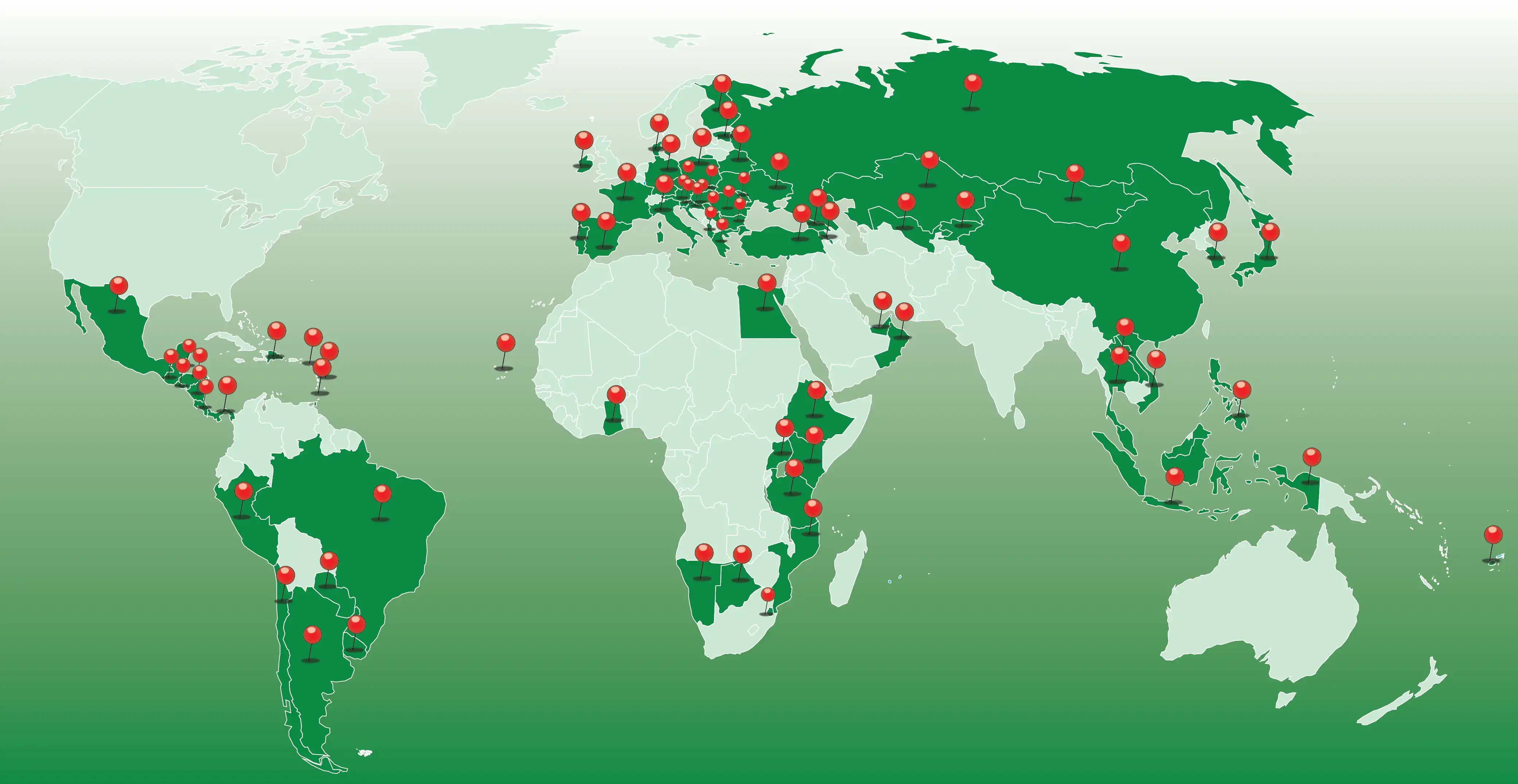
Nevertheless, the attractiveness of utility models is also increasing internationally. According to WIPO, application numbers worldwide have continuously climbed in the past years. In 2024, a total of 3.3 million utility model applications were filed globally.
Additional information on utility model protection is available on our website.