
Insight Our Strategy
We continued the consistent implementation of our strategic processes in 2025.
As before, the focus remained on our users and services. It is our goal to continuously drive the DPMA forward and, notwithstanding the ever-changing environment, offer customised services that efficiently support and help our clients. For this purpose, we maintain a close dialogue with our users.
In order to achieve our strategic goals, we are constantly defining tailored measures. In 2025, we successfully completed several measures and simultaneously launched new ones.
Sustainability remains a high priority for the DPMA. We completely implemented our first measure in this area, thus aligning our office with the federal government’s sustainability strategy. In doing so, we take a holistic view of the topic of sustainability and don’t limit ourselves to purely ecological aspects — even though, of course, these continue to be particularly important. To develop this topic in a transparent and visible manner, we have now also embedded sustainability within our organisational structure and set up a follow-up measure for the introduction of EMAS (Eco-Management and Audit Scheme) as well as for the management of mobility and energy data.
In order to intensify the structured exchange with our users, we were able to successfully complete the measure “Survey service”. Our office’s survey service has become well-established and will continue to feed back important suggestions and recommendations from external sources to the DPMA. You can find more detailed information about this topic in our Annual Report 2024.
One key pillar that keeps all of our operations running is our IT department:
To ensure that our processes run smoothly, we not only need our expert applications, but also a modern and efficient infrastructure. We are therefore modernising our data centre to prepare for upcoming technologies. While doing so, data security, data protection and a high availability are of the highest priority for us.
When it comes to designs, we are still working on the introduction of the electronic IP case file. The implementation is scheduled for March 2027, immediately followed by the adjustments due to the design reform.
With DPMAdirektPro und DPMAdirektWeb, we offer two established and professional tools for filing applications for trade marks and patents. In the future, we aim to combine them in one homogenous, modern and intuitive application portal. For this, the perspective of our users is very important to us. We have already gathered suggestions and wishes via our User Advisory Council and are continuing this process with selected user groups. We have also already begun planning for the new user portal and started working on it.
In 2025, we also continued to expand our office-wide business process management. To embed this even further within the DPMA, we initiated a corresponding follow-up measure.
Our Project: Move to the new office building Concentrated technical expertise
In Munich, the moving boxes were getting packed up: for a long time, the patent and utility model divisions at the DPMA’s headquarters were spread across three locations. Now they share a new home in a modern office building. For our organisation this means: an incredible amount of technical expertise concentrated under one roof.
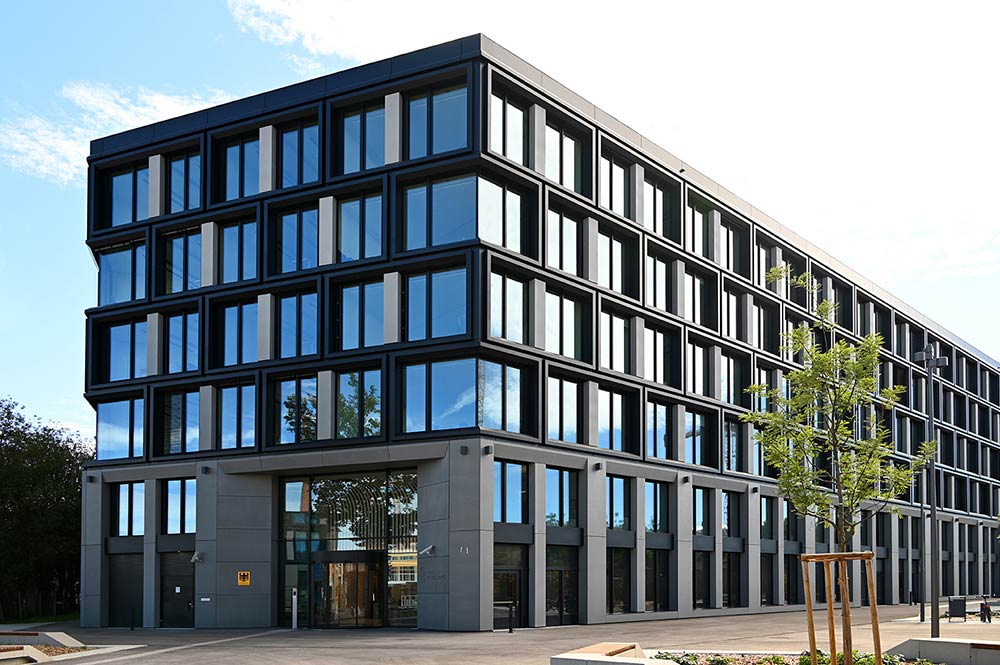
Bringing everyone together under one roof – the new office building for Directorate General 1 in Munich
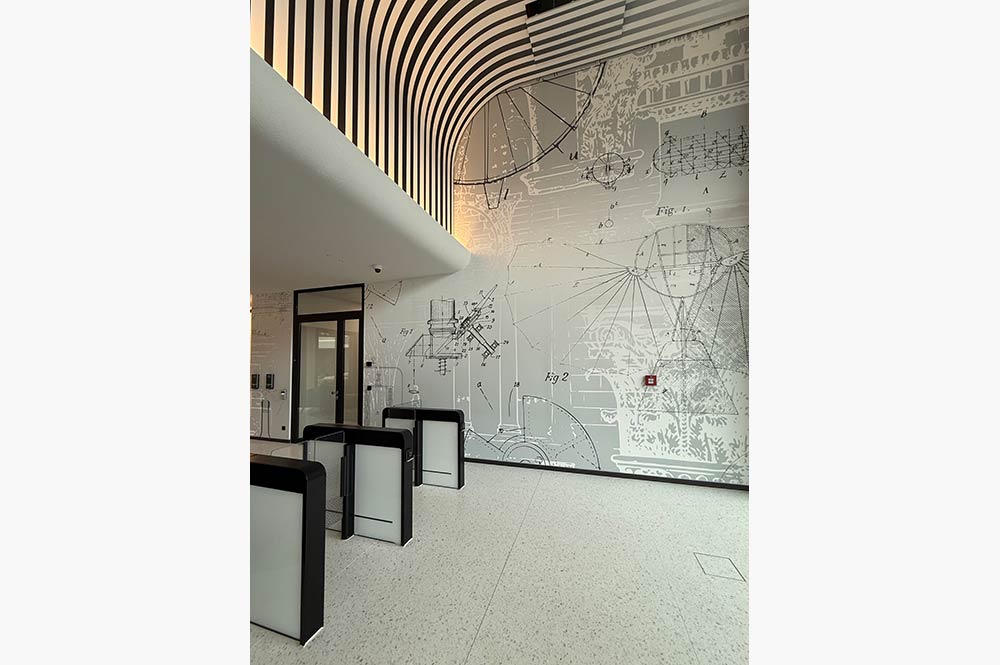
Patent drawings adorn the walls in the entrance area.
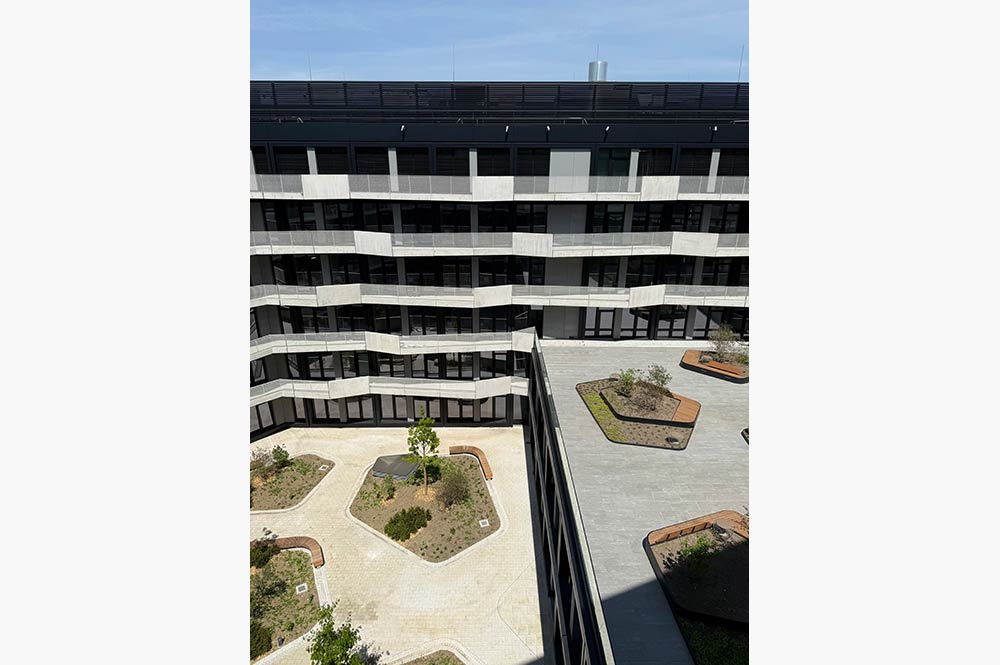
The landscaped courtyard offers employees a place to meet and exchange ideas during the workday.
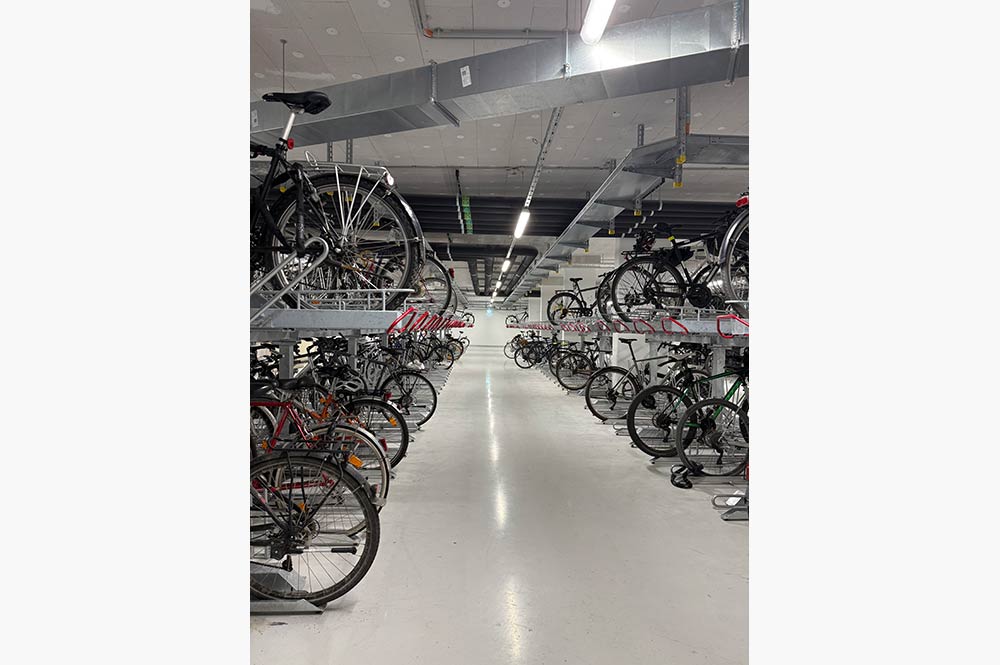
With ample parking capacity, the cycle storage room offers modern amenities for employees.
At the beginning of 2025, we successfully completed a key project: the Munich colleagues of Directorate General 1 “Patents and utility models” moved into a new office building at Anzinger Straße. The staff of Directorate General 1 includes the patent examiners – experts from various fields of technology and science who examine technical inventions and grant them protection if they fulfil the corresponding requirements.
The successful completion of the project is mainly the result of strong teamwork: staff from our specialist areas, facility management, IT departments, interest representatives and external partners worked hand in hand to keep day-to-day operations running. Even unexpected challenges – such as technical outages or delays in construction – were overcome together. The move thus became a project that also strengthened the organisation’s culture.
The scale of the move can best be expressed in numbers: the teams emptied around 1,000 rooms, moved around 14,500 pieces of furniture and set up 1,294 new IT workspaces. In only 80 days, files, furniture and technology changed their location. Due to the complex IT systems for sensitive data, the move was also a major project for the IT department.
The new building offers our staff a modern work environment with private spaces for focused work as well as areas that foster interaction and exchange. The building also has a cafeteria as well as a library and a nursery. For exercise and mobility, there are a sports room and a big parking area for bikes in the on-site underground car park.
The move to the new office building marks the beginning of a new chapter. The colleagues of the Directorate General 1 in Munich now all have their workplace under one roof. The distances have become shorter, the exchange more direct, the cooperation closer. While before people had to communicate across different locations, now spontaneous meetings are possible in the hallway or while getting a coffee. The building creates space for exactly this kind of connection. At the same time, if offers modern working conditions: a high-performance IT infrastructure, up-to-date workspaces and flexible options to combine working at the office with mobile working. All this leads to an environment that not only enables more efficient processes, but also a more attractive workplace in general.
The neighbourhood itself provides further impetus: the new office is located in the middle of the Munich Werksviertel, one of the most dynamic areas of the city. Right next to us, start-ups develop innovative ideas, new business models arise and creative networks are built. Institutions like start-up centres and innovation platforms shape the atmosphere – this is an environment that not only thinks the future, but creates it. For an organisation whose daily business consists of technical inventions and their protection, this closeness is more than a locational advantage: it is an inspiration.