Content
iENA trade fair 2026
Baby Dreams, Dog Aid, Fight the K.O. Drops
At the  iENA trade fair in Nuremberg, the DPMA and partner organisations provide information on patents, utility models, trade marks and designs. Hundreds of inventors are once again presenting their innovations there – and many are thinking about protection right from the start.
When AI saves dogs: an early warning system for epileptic seizures
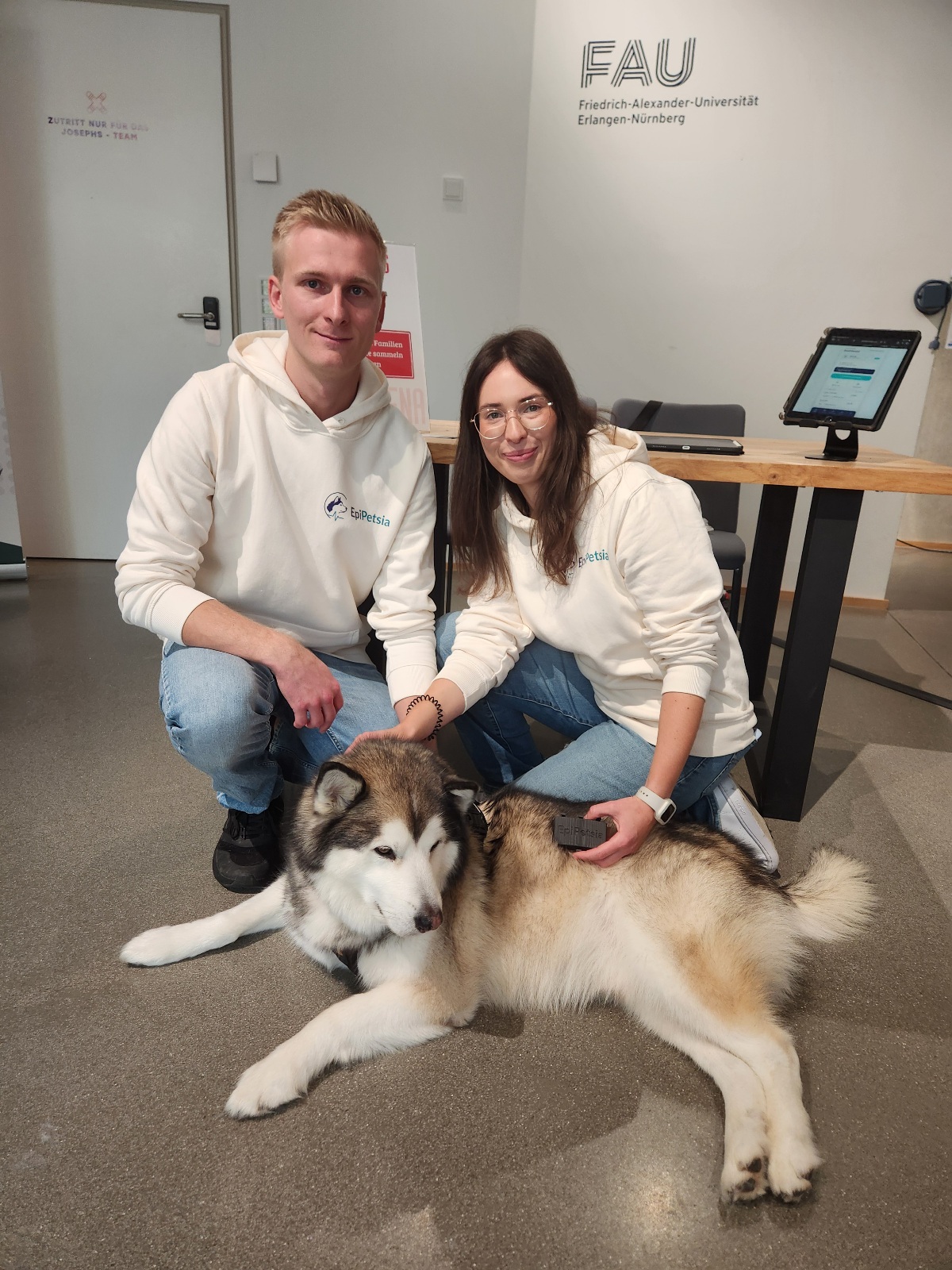
Leonie Altmann and Jonas Ernst with Nannok
The journey that took Leonie Altmann and Jonas Ernst to the iENA inventors' fair in Nuremberg got off to a dramatic start: two years ago, the pair were on holiday in their camper van with their dog, "Nanook". One morning, somewhere in the middle of nowhere, their cuddly and good-natured Alaskan Malamute started making strange noises and moving in a peculiar way. "He's just playing around again, I suppose," thought Jonas Ernst, still half asleep. Leonie Altmann was already a bit more awake and immediately alarmed. She woke her boyfriend: "The dog’s dying!"
It turned out all right in the end; "Nanook" survived. But it was serious nonetheless. It turned out that the dog had had an epileptic fit. This happens to animals too – and apparently isn't all that rare. Three to five dogs die from this every day. That's an expert estimate the pair came across in their research. Their dog is now receiving treatment; medication is available for animals too, if needed. But the risk remains – as does the constant worry for dog owners. After all, you never know when or where a seizure will occur – or whether you'll even notice it in time.
That's how Altmann and Ernst, now aged 28 and 27 – who were still Master’s students at the time – came up with their idea: they want to develop an AI-powered early-warning system for dogs. It is designed to record movement and health data via the dog’s collar and transmit this to owners via an app – and then, ideally, raise the alarm in good time. The pair are still in the early stages, but they have the expertise. Both have completed the "Simulation and Testing" engineering degree at Coburg University – and already have considerable experience in AI development. As a next step, they want to collect data from affected individuals in order to devise a suitable algorithm. At iENA, they are hoping to make contacts and gather ideas.
The trade fair is one of the largest of its kind. It is also one of the most important events, particularly for so-called independent inventors who do not work in the development departments of large companies or research institutions. Here, they can publicise their new inventions and find companies to act as partners, licencees or buyers.
A gravel path for sweet dreams: a clever invention for pushchairs
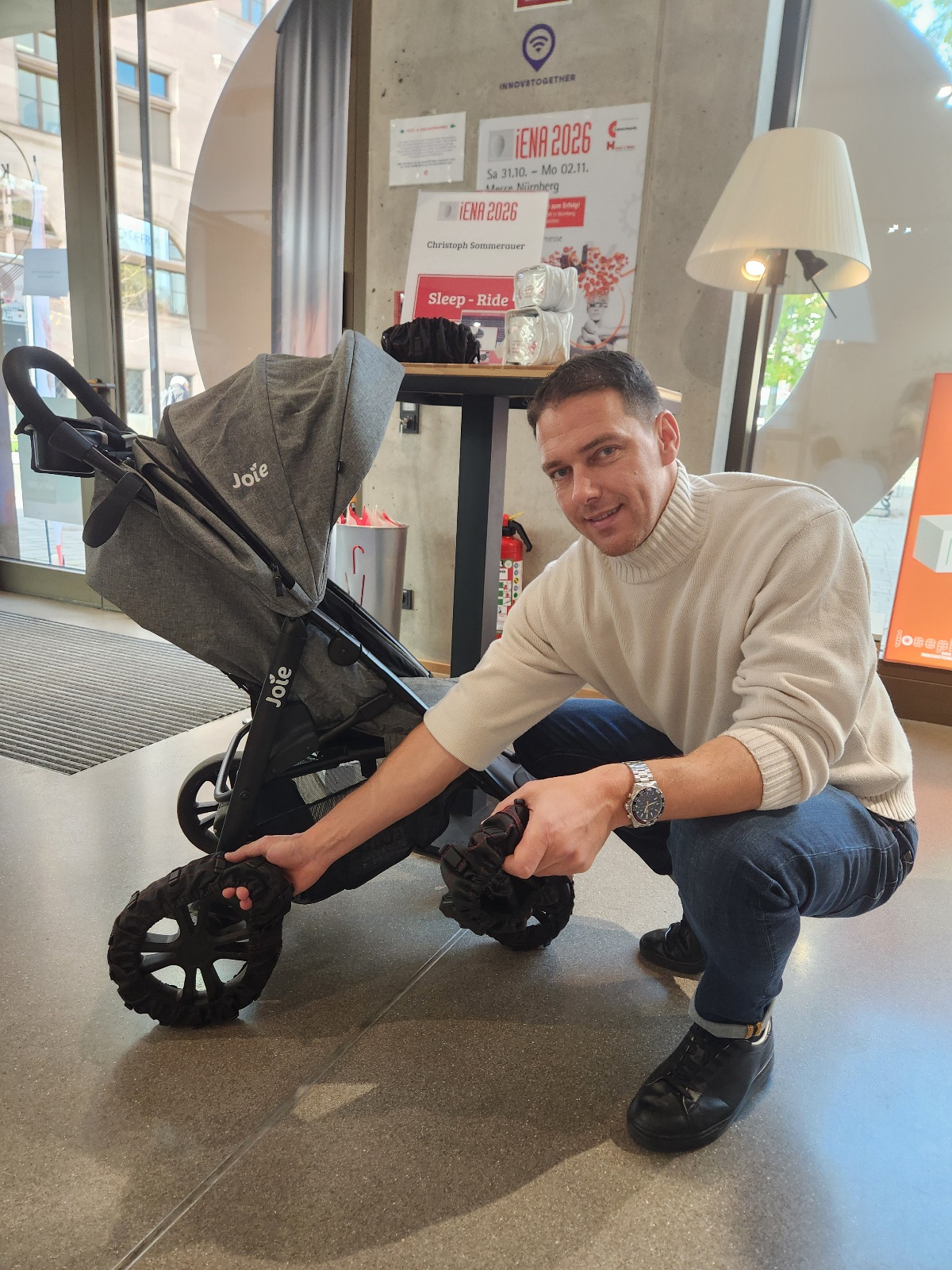
Christof Sommerauer
One such inventor is Christof Sommerauer from Altdorf near Nuremberg. He is, in effect, already presenting a product ready for the market: the "Sleep Ride". Sommerauer's invention, too, has its origins in his private life. To be more precise: in his role as a father. A few years ago, when he went out in his new housing estate to push his child to sleep in the pram, he noticed that everyone in the estate pushing a pram ended up on the same path. It was the only gravel path, and as babies and toddlers are known to fall asleep best when the pram jolts back and forth, the path was always quite crowded. "It doesn’t have to be like that," Sommerauer thought to himself. "The gravel path must come to the pushchair, not the other way round."
So he developed the "Sleep Ride" – a tyre cover that wraps around the pram’s tyre using an elastic band, much like a fitted sheet. The cover features hard rubber attachments that create a bumpy sensation whilst the pram is in motion. This creates the sensation of a gravel track even on the smoothest surfaces. Sommerauer, whose main job is in procurement at a large technology company, knows that one should not take such an idea to a trade fair without protection. After all, only something that has not yet been published can be protected by a patent. For utility models, however, there is at least a six-month grace period during which an application can still be filed even after publication. Some time ago, he registered a utility model for his design principle with the German Patent and Trade Mark Office (DPMA). In this way, he hopes to prevent anyone from copying it with impunity.
Good ideas need protection: Why inventors should think about patents, trade marks and designs at an early stage
The DPMA will be providing information on these connections and other aspects of intellectual property rights – including patents, utility models, trade marks and designs – at its large stand at iENA. Experts will be on hand throughout the three days of the fair (31 October to 2 November) to provide information (Hall 4, stand number A20). Experts from the World Intellectual Property Organisation, the European Patent Office, the European Union Intellectual Property Office and the ‘Bayern Innovativ’ agency will also be on hand to provide information. The Federal Ministry for Economic Affairs and Energy will be providing advice on funding opportunities for intellectual property applications. Furthermore, a female patent attorney and a male patent attorney will be offering inventors free initial consultations. Appointments for these can be arranged at the DPMA stand.
Party safely without "knockout" drinks: an NFC ring protects your drink
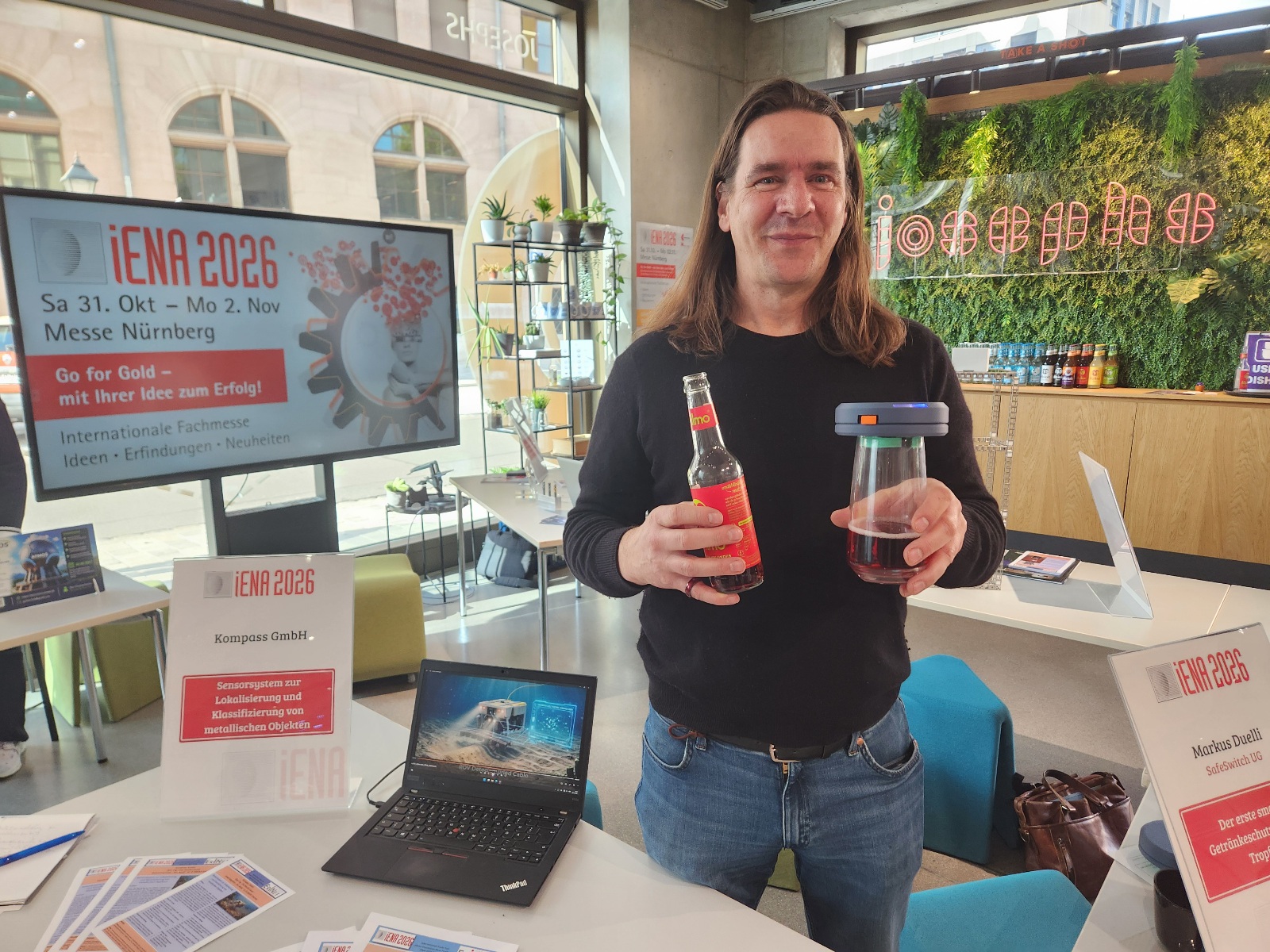
Markus Duelli
Markus Duelli from Ilmenau has moved beyond the initial stage of seeking advice as an inventor. He has long since filed a patent and a utility model application for his invention. The invention is designed to solve a problem that he, too, became aware of through his children: unfortunately, there has for some time been a growing criminal trend at parties whereby so-called ‘knock-out drops’ are secretly mixed into drinks to render people unconscious. Duelli thought about how he could protect his children – and himself – from such perpetrators – and developed the "SafeSwitch".
In this system, a ring worn on the finger communicates via an NFC (Near Field Communication) chip with a lid on a drinks glass. The plastic lid seals the drink with a silicone locking mechanism that presses against the rim of the glass. The locking mechanism can be opened contactlessly using a ring worn on the finger (and only with this ring). So you can safely leave your covered glass at the bar, go off dancing and then enjoy your drink again without any worries. A patent has been filed for the operating principle, whilst a utility model has been registered for the special silicone lock, which can cover everything from a slender champagne glass to a wide caipirinha glass.
Duelli initially self-funded the development and production of the SafeSwitch through his family business. A crowdfunding campaign will launch online on 9 November – in the hope of securing financial support from interested customers. Duelli intends to try marketing it on his own for the time being. But who knows what else might come of the iENA trade fair.
Image 1: iENA, Images 2, 3, 4: DPMA/Til Huber
Last updated: 2 November 2026
Not only protecting innovations
Social Media