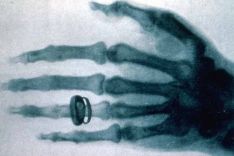
It all began on a late Friday evening in Würzburg, November 8, 1895, when Wilhelm Conrad Röntgen made one of the most famous discoveries in the history of science: an unknown, invisible form of radiation.
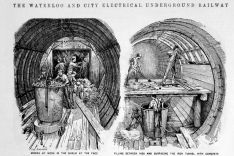
It was the world's first underground transport tunnel: the Tower Subway. A rail car shuttled back and forth under the river between the banks of the Thames - a much admired technical innovation in 1870. Even though the narrow iron tube was only used for a few months, it set a milestone in the history of transport.
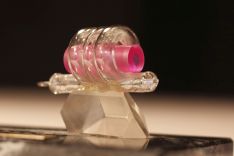
When Theodore H. Maiman switched on a flash discharge lamp wrapped around a rod-shaped ruby in Malibu on 16 May 1960, a laser flashed for the first time. One of the most important inventions of the 20th century was made. To commemorate this moment, UNESCO celebrates the World Day of Light every year.
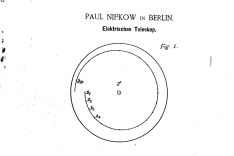
For more than half a century, television was the most important medium for mankind. Today, as its importance is declining in the face of the digital revolution, it is worth taking a look at its roots. It began with the idea of a lone student.
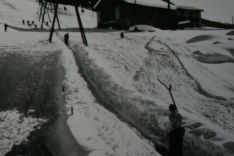
Winter season! Many people are now heading towards mountains for skiing. But this winter fun would never have become a mass sport if there hadn't been some helpful inventions: The first ski lift with bars to cling on went into operation in Davos in 1934.
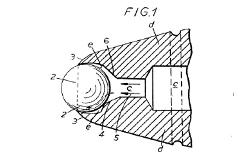
He invented one of the most produced devices in history, but hardly profited from it: László Bíró is the father of the modern ballpoint pen, which still bears his name in many countries today.
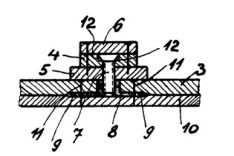
To this day, a football legend persists: Adi Dassler, so the tale goes, made a decisive contribution to the "Miracle of Bern" with the screw-in studs he invented. But Dassler did not invent the screw-in studs at all. On 30 August 1949, Alexander Salot applied for a patent for "replaceable anti-skid studs".
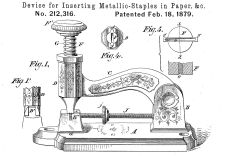
Today we dedicate ourselves to a species threatened with extinction: the stapler. While this device could be found in large numbers for more than a century in all offices around the world, today its habitat is increasingly threatened by digitalization.
September 28, 1928 is one of the most important dates in the history of medicine. On this day, the Scottish doctor Alexander Fleming observed that a mould can kill bacteria. The method of action of penicillin was discovered.
Now that's a sweet story: Because his wife is said to have injured herself while breaking sugar, Jacob Christoph Rad invented cube sugar. Until then, sugar could only be bought in the shape of cones or loafs.
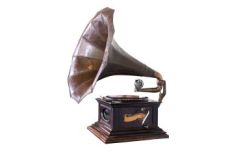
When Emil Berliner was granted a patent for his "Method and Apparatus for the Registration and Reproduction of Tones" (DE45048) in 1887, music became available without musicians.
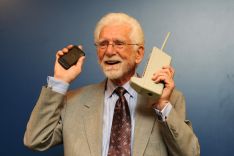
There are only a few inventions that have really changed people's lives forever. Apart from the Internet, nothing in recent decades has influenced communication, social behaviour, the world of work and leisure more fundamentally than the mobile phone.
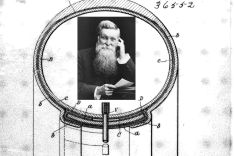
In 1888, John Boyd Dunlop could no longer watch his son struggle on a tricycle with hard rubber tyres on the bumpy road surface in Belfast and invented the air-filled tyre for him. But Dunlop was not the first to make this invention. The patent Dunlop received should never have been granted.
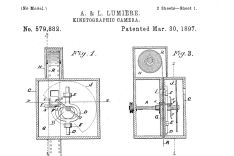
With this patent the success story of cinema began: On 13 February 1895, the brothers August and Louis Lumière applied for a patent in France for an "Appareil servant à l'obtention et à la vision des épreuves chrono-photographiques". With the "Kinematograph", the moving image started conquering the world.
He was one of the greatest composers of all time: Ludwig van Beethoven. But his life was overshadowed by the loss of his hearing - a suffering that can be well alleviated today thanks to some inventions.
The umbrella is a practical invention. But a canopy to take along is even more practical when it can be folded up so small that it fits in every pocket. We owe this idea to Hans Haupt, who applied for a patent for a "shortenable umbrella" on April 26, 1930. He called his pocket umbrella "Knirps" (munchkin, tyke, tiddler).
Every invention is worthless as long as you do not know what you can use it for. Sometimes it takes years to find the right application for a development. One of the best known examples are the "Post-it" stickers.
This invention has saved the lives of countless people: On August 29, 1958, a patent application was filed in Sweden for the three-point belt. Nils Ivar Bohlin, engineer at the car manufacturer Volvo, thus brought the safety belt for vehicles, which had been known for over 50 years, into its current form.
On 20 January 1885, one of the first patents for a roller coaster was granted: US310966A "Roller coasting structure" by L.A. Thompson. He had built a "Switchback Railway" the year before on Coney Island. This marked the beginning of the roller coaster's unbroken triumphal ride into amusement parks around the world.